

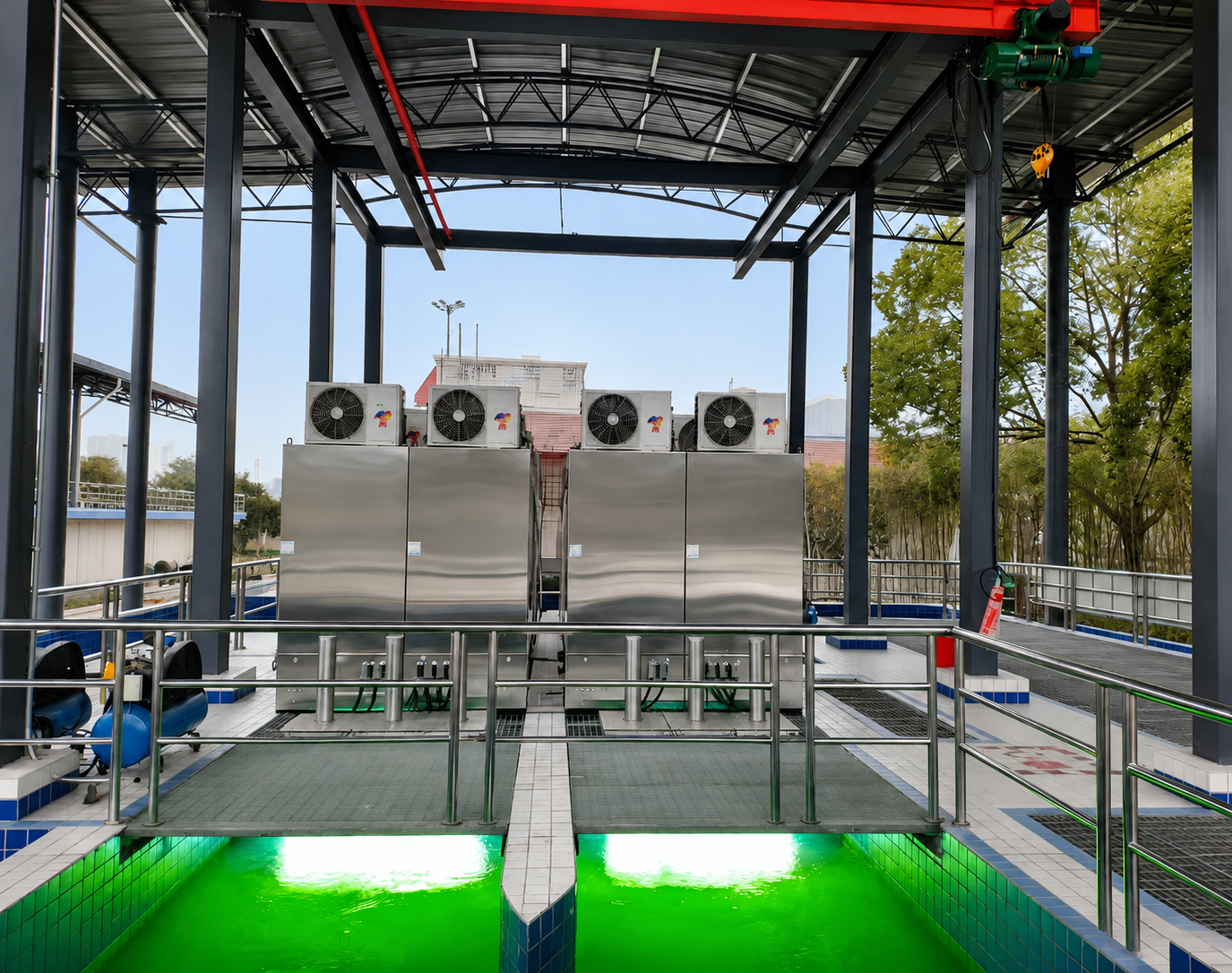
An open-channel UV disinfection system is one of the most widely used UV configurations in municipal wastewater treatment plants. Treated effluent flows by gravity through a concrete or stainless-steel channel, and banks of UV lamp modules installed directly in that channel inactivate the microorganisms it carries before discharge or reuse.
The configuration is widely used because it fits the way most municipal plants already work: gravity flow, large and variable volumes, and existing channels downstream of secondary or tertiary treatment. Its performance, however, depends on how the modules, the channel hydraulics, the water level and the control system work together. This article explains how open-channel UV systems operate, how they are integrated into existing plants, how automatic control and dose pacing work, and which criteria help decide between an open-channel and a closed-vessel design.
For the general design principles of UV in wastewater, including UV transmittance, suspended solids and validation, see our UV disinfection design guide for wastewater treatment and water reuse.
How an open-channel UV disinfection system works
In an open-channel system, the UV lamps are housed in quartz sleeves and mounted on removable modules. The modules are grouped into banks and placed across the width of the channel, so that all the effluent has to pass between the lamps. Where a single bank cannot deliver the required dose, two or more banks are installed in series along the channel. Where the flow is too large for one channel, several channels operate in parallel.
Lamps can be arranged in two main ways:
Horizontal modules, with lamps parallel to the flow, stacked in rows from the channel floor to just below the water surface. This arrangement is common in small and medium plants and in retrofits of existing channels.
Vertical modules, with lamps perpendicular to the flow and standing upright in the channel. Vertical designs are often used for higher flows or where footprint, water depth or hydraulic conditions favor them.
Municipal open-channel systems usually use low-pressure amalgam lamps, which emit most of their output at the germicidal wavelength of 254 nm and offer high UV output per lamp with good electrical efficiency. Higher lamp power can reduce the number of lamps, modules and maintenance points needed for a given flow, provided the hydraulic and dose distribution are designed accordingly.
The dose each microorganism receives depends on the light intensity it is exposed to and the time it spends between the lamps. In an open channel, both factors are strongly influenced by the water level, the velocity profile and how evenly the flow is distributed across the modules. This is why the channel is part of the reactor, not just a structure that holds it.
Main components of an open-channel UV system
A complete open-channel installation includes more than the lamp modules:
UV modules and lamps, sized and arranged for the design flow, the minimum expected UV transmittance (UVT) and the required inactivation.
Quartz sleeves and an automatic cleaning system, which removes deposits from the sleeves while the system remains in operation.
UV intensity sensors, which monitor the light reaching the water and detect losses caused by fouling, lamp aging or changes in water quality.
A water level control device, such as a fixed weir, a counterweighted gate or a motorized gate, which keeps the lamps submerged at the correct depth.
Power and control cabinets, with electronic ballasts, a PLC, an HMI and communication with the plant SCADA.
Optional instruments, such as an online UVT analyzer or a flow signal from the plant, used for dose pacing.
Why open-channel UV suits municipal wastewater plants
Open-channel UV is well suited to municipal applications for practical reasons:
Gravity flow and low head loss. The system works with the hydraulic profile most treatment plants already have, without pumping or pressurized pipework.
Modularity. Capacity can be adjusted by adding modules, banks or channels, which helps when a plant is expanded in phases or when seasonal flows vary.
Access for maintenance. Modules can be lifted out of the channel from above for inspection, lamp replacement and sleeve checks, often while other banks or channels remain in service.
Use of existing civil works. Former chlorine contact tanks and existing effluent channels can often be adapted to host UV modules.
The configuration also has requirements that must be addressed in design. The channel needs suitable dimensions, a stable water level and a uniform approach flow. Open channels are exposed to weather, sunlight and algae growth, so covers, access safety and the location of electrical equipment should be considered. These points do not make open-channel UV less suitable for municipal plants, but they need to be part of the project from the start.
Integrating UV modules into existing channels
Many municipal projects involve installing UV in an existing channel, either replacing chlorination or upgrading an older UV system. A successful integration starts with a review of the existing infrastructure, not with the choice of modules.
The review should confirm:
Channel width, depth and length, and whether they allow the required number of banks plus space for level control.
The available hydraulic head, since modules and level control devices add head loss.
Upstream flow distribution, as bends, inlets or sudden expansions can create uneven velocities across the lamp banks.
The minimum and maximum water levels at the module location across the full flow range.
Bypass or isolation arrangements that allow maintenance without stopping disinfection.
Power supply, cable routes and the location of control cabinets.
When the existing channel does not provide uniform flow, inlet baffles, perforated plates or changes in channel geometry may be needed before the first bank. In a retrofit, the dose must be recalculated for current conditions rather than copied from the original design, because flows, effluent quality and discharge requirements may have changed. Our article on UV plant retrofit for open-channel systems covers this process in more detail.
Water level control in open-channel UV
Water level control has a direct effect on disinfection performance. If the level rises too high above the top row of lamps, part of the effluent can pass through a zone where UV intensity is low, receiving less than the required dose. If the level falls too low, the upper lamps may be exposed to air, which can cause overheating and sleeve deposits and reduces the effective treatment capacity.
Common level control options include:
Fixed weirs, which are simple and reliable but may allow the level to vary with flow.
Counterweighted or flap gates, which respond mechanically to flow and keep the level within a narrower range.
Motorized level control gates, which use level sensors to maintain a set point across a wide flow range.
The right option depends on the flow range, the available head and the configuration of the modules. In all cases, a low-level sensor should protect the lamps and generate an alarm if the water level falls below the safe operating limit.
Automatic control and dose pacing
Municipal wastewater flows change throughout the day and across the year. A system that runs at full power at all times delivers the required dose during peak conditions but wastes energy during the rest of the day. Dose pacing adjusts UV output to actual treatment demand.
A dose pacing system typically uses:
The plant flow signal, which indicates how much water must be treated.
UV intensity sensor readings, which reflect lamp output, sleeve condition and water quality.
Where installed, an online UVT analyzer, which measures how much UV light the effluent absorbs.
With this information, the control system can switch banks on and off or modulate lamp power, while keeping the delivered dose above the required value. The adjustment must stay within the range in which the system has been sized or validated. If a flow, intensity or UVT signal is lost or out of range, the system should switch to a predefined fail-safe strategy: an alarm is generated and the control responds as defined for that situation, for example by moving to a conservative operating mode, rather than relying on uncertain data.
Automatic control also covers monitoring and protection: lamp and ballast status, cleaning cycles, sensor readings, low-level protection, alarm history and remote communication with SCADA. Good alarm design helps operators distinguish between a lamp failure, a fouling problem and a change in incoming water quality, which require different responses.
For the relationship between dose, UVT, suspended solids and hydraulics, see how to define UV dose, UVT and the hydraulic design window in open-channel UV.
Maintenance and operation
An open-channel UV system keeps its performance only if the light reaching the water stays at the design level. The main maintenance tasks are:
Sleeve cleaning. Automatic wiping systems remove deposits during operation. Their frequency should be adjusted to the fouling observed at the site, which depends on hardness, iron, organic matter and upstream treatment.
Lamp replacement. Lamp output decreases over time. Replacement should be planned according to operating hours, measured intensity and the manufacturer's rated life, so that the system still delivers the required dose at end of lamp life.
Sensor checks and calibration. UV intensity sensors and UVT analyzers need periodic verification, since decisions about dose and alarms depend on their readings.
Inspection of seals, wipers and level devices. Worn wipers, damaged seals or a blocked gate can reduce performance gradually without causing an immediate alarm.
Redundancy should be defined according to the consequences of losing disinfection capacity. Depending on the project, this may mean a standby bank, an additional channel or a module arrangement that allows maintenance while the required dose is maintained in the remaining equipment.
Open-channel or closed-vessel UV: selection criteria
Open-channel UV is not the right answer for every project. Closed-vessel (in-line) UV reactors are installed in pressurized pipework and are often preferred for smaller flows, compact sites, pumped systems or industrial applications where the effluent is already in a pipe.
Open-channel UV is usually the stronger option when:
The plant has gravity flow and limited head available for additional losses.
Flows are medium to large or expected to grow in phases.
Suitable channels already exist or can be built at reasonable cost.
Operators need direct access to modules for maintenance.
A closed-vessel reactor may be more suitable when:
The effluent is pumped or already flows through pressurized pipework.
The available footprint is small or the installation must be enclosed.
Flows are relatively low and the plant does not have channels that can be adapted.
Whichever configuration is chosen, the selection should be based on the same project data: design and peak flow, minimum flow, minimum expected UVT at 254 nm, suspended solids, the required microbial reduction or target dose, the applicable discharge or reuse requirements, the available head and space, and the required integration with plant control.
Longking's open-channel UV systems
Longking EnTech Europe designs and supplies open-channel UV systems for municipal wastewater discharge and water reuse. Its NLQ range includes horizontal configurations (NLQ-H) for small and medium flows and channel retrofits, and vertical configurations (NLQ-V and NLQ-HPV) for higher capacities or different hydraulic and footprint requirements. The NLQ 800 HPV, for example, uses 800 W low-pressure amalgam lamps to reduce the number of lamps and modules required per channel.
The systems combine modular lamp units, automatic sleeve cleaning that operates without stopping disinfection, UV intensity monitoring, low-level protection and PLC-based control with dose pacing and SCADA communication.
Equipment is only part of the solution. Each project starts with process sizing based on the plant's flows, effluent quality and disinfection objective, followed by a review of the channel geometry, hydraulics and level control. Systems are tested before shipment through factory acceptance testing, and Longking supports commissioning, operator training, remote monitoring, maintenance and spare parts. This approach was applied, for example, in the open-channel UV system for the Villafranca de los Barros WWTP.
Where a plant needs additional treatment barriers, such as tertiary filtration before UV, open-channel disinfection can be integrated into a multi-barrier treatment approach.
Designing open-channel UV around the real plant
An open-channel UV disinfection system is a practical and efficient choice for most municipal wastewater plants with gravity flow. Its performance depends on the combination of lamp modules, channel hydraulics, level control, cleaning and automatic control, all sized for the plant's actual flows and effluent quality.
The most reliable installations are designed from representative data, integrated carefully into existing channels, and operated with control strategies that maintain the required dose while reducing energy use. That combination is what turns UV equipment into dependable disinfection for discharge and reuse.
Are you planning a new UV installation or the upgrade of an existing disinfection channel? Contact the Longking EnTech Europe team to review your plant data and find the most suitable UV configuration for your project.
Frequently asked questions
What is an open-channel UV disinfection system?
It is a UV system in which lamp modules are installed directly in an open channel through which treated wastewater flows by gravity. The effluent passes between the lamps and is exposed to UV-C light, which inactivates bacteria, viruses and protozoa.
Can UV modules be installed in an existing chlorine contact channel?
Often, yes. The channel dimensions, available head, flow distribution and water level must be checked first, and the UV dose must be calculated for current flows and effluent quality.
What is dose pacing in UV disinfection?
Dose pacing is a control strategy that adjusts lamp power or the number of active banks according to flow, UV intensity and, where measured, UVT. It reduces energy use while keeping the delivered dose above the required value.
When is a closed-vessel UV reactor preferable to an open-channel system?
Closed-vessel reactors are generally preferred when the effluent is pumped or already in pressurized pipework, when space is limited, or when flows are relatively small and no suitable channel exists.
Technical references
U.S. Environmental Protection Agency (1999). Wastewater Technology Fact Sheet: Ultraviolet Disinfection (EPA 832-F-99-064).
National Water Research Institute (2012). Ultraviolet Disinfection Guidelines for Drinking Water and Water Reuse, 3rd ed. NWRI, in collaboration with the Water Research Foundation.
U.S. Environmental Protection Agency (2006). Ultraviolet Disinfection Guidance Manual for the Final Long Term 2 Enhanced Surface Water Treatment Rule (EPA 815-R-06-007). Reference for reactor validation methodology, developed for drinking-water applications.
International Ultraviolet Association (IUVA). Technical resources and guidance on UV disinfection.
Regulation (EU) 2020/741 of the European Parliament and of the Council of 25 May 2020 on minimum requirements for water reuse.