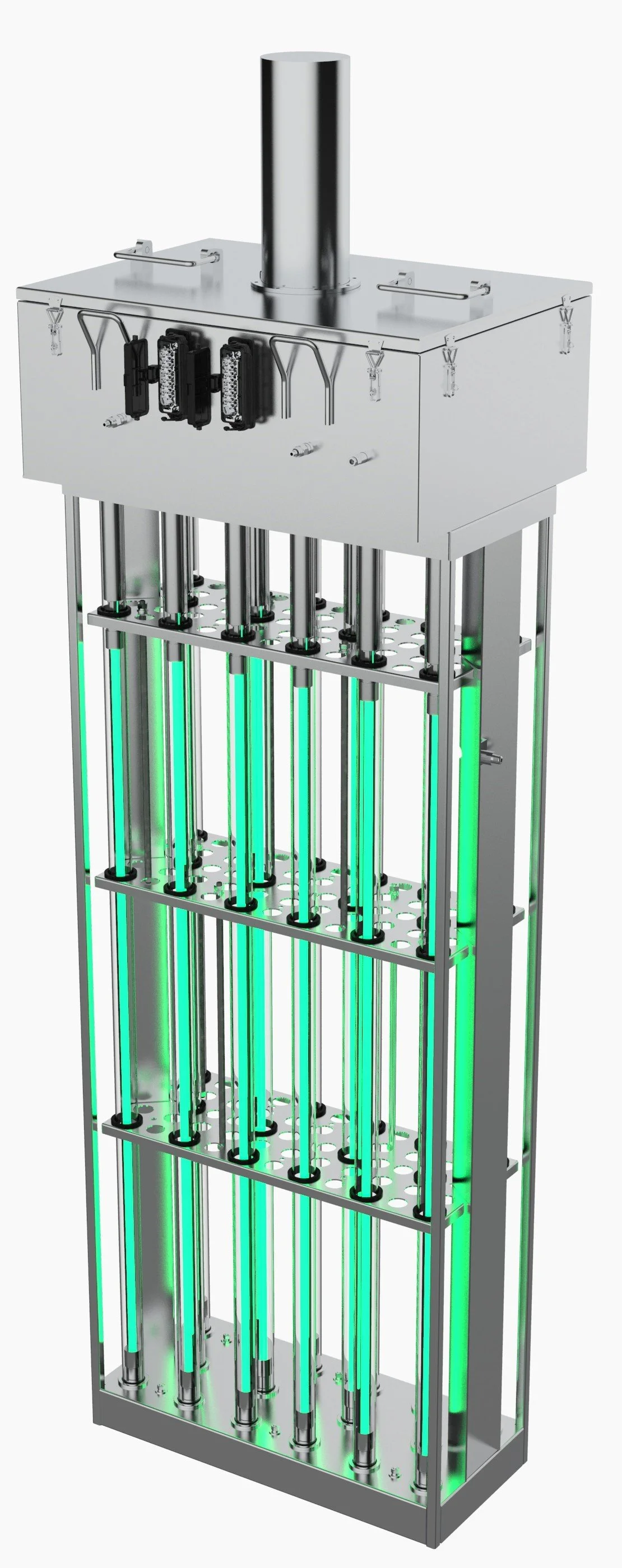
Open-Channel UV Disinfection Systems for Water Treatment
UV-C Disinfection for Wastewater, Water Reuse & Industrial Applications
Longking designs and delivers open-channel ultraviolet (UV-C) disinfection systems for municipal wastewater, water reuse and industrial water treatment applications.
Our NLQ platform combines low-pressure amalgam UV lamps, optimized channel hydraulics, automatic quartz-sleeve cleaning, UV monitoring and PLC-based control to provide reliable disinfection under varying operating conditions.
The range includes the NLQ-H horizontal 320 W platform and the NLQ-HPV high-power vertical 800 W platform, allowing the system architecture to be adapted to different flow rates, channel geometries and project requirements.
Each UV system is engineered according to the actual operating window, considering parameters including flow rate, UV transmittance (UVT), suspended solids, target UV dose, hydraulic conditions, redundancy and required microbiological performance.
From new wastewater treatment plants to retrofit and capacity-expansion projects, Longking develops the UV system together with the hydraulic, electrical and automation interfaces required for integration into the complete treatment plant.
What is UV-C Disinfection?
UV-C disinfection is a physical treatment process that uses short-wavelength ultraviolet radiation to inactivate microorganisms present in water.
The germicidal UV-C region extends approximately from 200 to 280 nm. Longking's low-pressure amalgam lamps emit predominantly at around 254 nm, a wavelength widely used for water disinfection because of its effectiveness in producing photochemical damage to microbial genetic material.
Unlike oxidation or chemical disinfection processes, UV treatment acts directly through irradiation and does not require the addition of a chemical disinfectant to the water.
How UV-C Inactivates Microorganisms
When bacteria, viruses and other microorganisms are exposed to sufficient UV-C radiation, the absorbed energy causes photochemical changes in their DNA or RNA.
These changes interfere with the organism's ability to replicate and infect, resulting in microbiological inactivation rather than physical removal of the microorganisms from the water.
The required UV dose depends on the microorganism and the required level of inactivation. Different microorganisms can therefore require significantly different UV doses to achieve the same log reduction. Published UV dose-response data show this variation clearly across bacteria, viruses and protozoa.
What Determines UV Disinfection Performance?
Effective UV disinfection depends on much more than lamp power alone. The system must deliver the required UV dose throughout the actual hydraulic operating range of the installation.
Key design parameters include:
Flow rate and hydraulic distribution
UV transmittance (UVT) at 254 nm
Suspended solids and particle content
Target UV dose and required log reduction
Lamp output and ageing
Quartz-sleeve fouling
Water level and lamp submergence
Channel geometry and hydraulic conditions
For open-channel systems, UVT, suspended solids, maximum flow and channel hydraulics are particularly important, since they directly influence the number of lamps, modules and banks required to achieve the design objective.
UV Dose
UV dose is commonly expressed in mJ/cm² and represents the amount of germicidal UV energy delivered to the water:
UV Dose = UV Intensity × Exposure Time
In a real UV installation, however, the effective dose cannot be determined from this simple equation alone. Lamp arrangement, water quality, UVT, fouling and hydraulic behaviour influence the dose received by microorganisms as they pass through the reactor or channel.
For this reason, Longking designs each UV system according to the specific operating conditions and required microbiological performance of the project, rather than selecting equipment solely on the basis of nominal lamp power.
Longking NLQ Open-Channel UV Technology
The Longking NLQ platform is a modular open-channel UV-C disinfection system developed for municipal wastewater, water reuse and industrial water treatment applications.
The platform combines low-pressure amalgam UV lamps, stainless-steel modules, automatic quartz-sleeve cleaning, UV intensity monitoring, water-level control and PLC-based automation within an architecture that can be adapted to different channel geometries and treatment capacities.
Three Configurations for Different Hydraulic Requirements
The NLQ portfolio includes three open-channel configurations:
NLQ-H — Horizontal, 320 W
Horizontal modules using 320 W low-pressure amalgam lamps. The configuration is particularly suitable for small and medium flows, wider channels and applications where straightforward module access is an important design consideration.NLQ-V — Vertical, 320 W
Vertical modules using 320 W low-pressure amalgam lamps, providing an alternative architecture where a vertical configuration and compact footprint are preferred.NLQ-HPV — High-Power Vertical, 800 W
Vertical modules using 800 W high-power amalgam lamps, designed for higher-capacity applications where increased lamp power can reduce the number of lamps and modules required for a given project.
The appropriate configuration is selected according to the design flow, UVT, suspended solids, required UV dose, channel geometry, hydraulic constraints and redundancy requirements.
Common NLQ System Architecture
Depending on the project configuration, an NLQ open-channel system can incorporate:
UV modules with lamps and high-purity quartz sleeves
Automatic pneumatic quartz-sleeve cleaning
UV intensity sensors
Ultrasonic water-level measurement
Fixed weir or motorized level-control system
Electronic lamp ballasts and power regulation
PLC + HMI control
Flow and/or UVT-based dose pacing
4–20 mA signals and industrial communications
SCADA integration
Alarm, interlock and operating-hour management
The modular architecture allows banks and modules to be arranged according to the required capacity, channel layout and operating philosophy rather than applying a single standard configuration to every plant.
Designed Around the Real Operating Window
UV system performance depends strongly on the actual conditions entering the channel.
For this reason, Longking designs each NLQ installation using the project's worst-case operating conditions, including maximum flow, minimum UVT, maximum suspended solids and required microbiological performance.
Hydraulic parameters such as channel width, water depth, allowable head loss, lamp submergence and flow distribution are evaluated together with UV performance to define the number and arrangement of banks, modules and lamps.
Automatic cleaning, stable water-level control and dose regulation help maintain repeatable operating conditions while allowing lamp power to respond to variations in flow and water quality.
Monitoring, Control & Plant Integration
The NLQ control system continuously supervises key equipment and process parameters, including lamp status, operating hours, UV intensity, water level, cleaning cycles and alarms.
Depending on project requirements, flow and UVT signals can be incorporated into the control strategy, while communication with the plant control system can be provided through 4–20 mA signals, Modbus and other project-specific industrial interfaces.
NLQ-H Series — Horizontal Open-Channel UV Disinfection
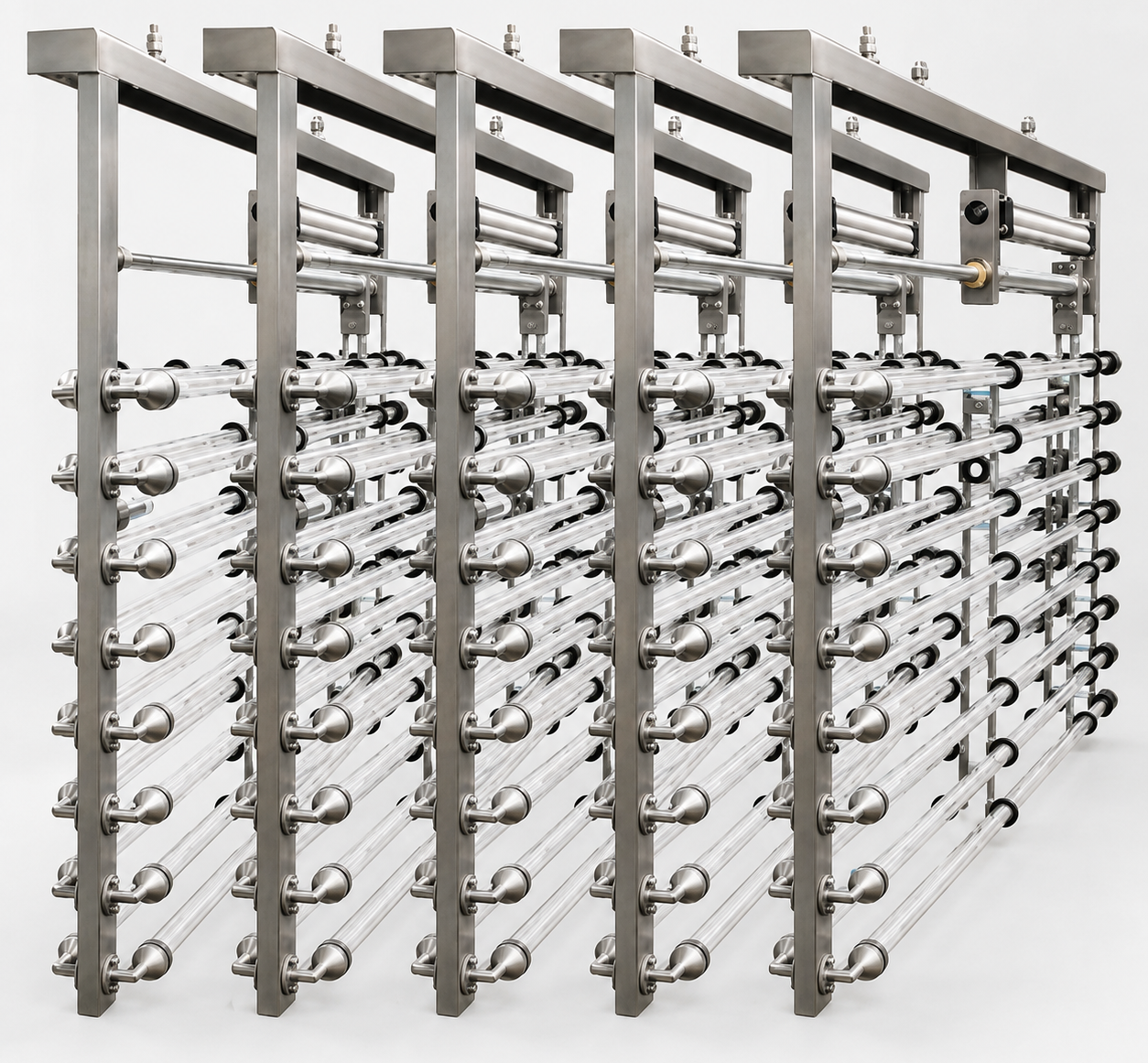
The Longking NLQ-H Series is a modular open-channel UV disinfection system based on a horizontal lamp configuration, developed for municipal wastewater, water reuse and industrial water treatment applications.
Its horizontal architecture is particularly well suited to projects where channel width, straightforward module access and flexible hydraulic integration are important design considerations.
Each system is configured according to the actual flow range, UVT, suspended solids, required UV dose, channel geometry and redundancy philosophy, rather than applying a fixed flow range to every installation.
320 W Low-Pressure Amalgam Lamp Technology
NLQ-H modules use 320 W low-pressure amalgam UV lamps with a nominal UV-C output of approximately 105 W at 254 nm.
A standard NLQ-H module can accommodate up to 16 lamps, with module and bank configuration adapted to the UV duty required by each project.
Longking's current technical documentation specifies a 12,000-hour guaranteed lamp operating life, with lamp-output performance defined according to the applicable project requirements and lamp ageing criteria.
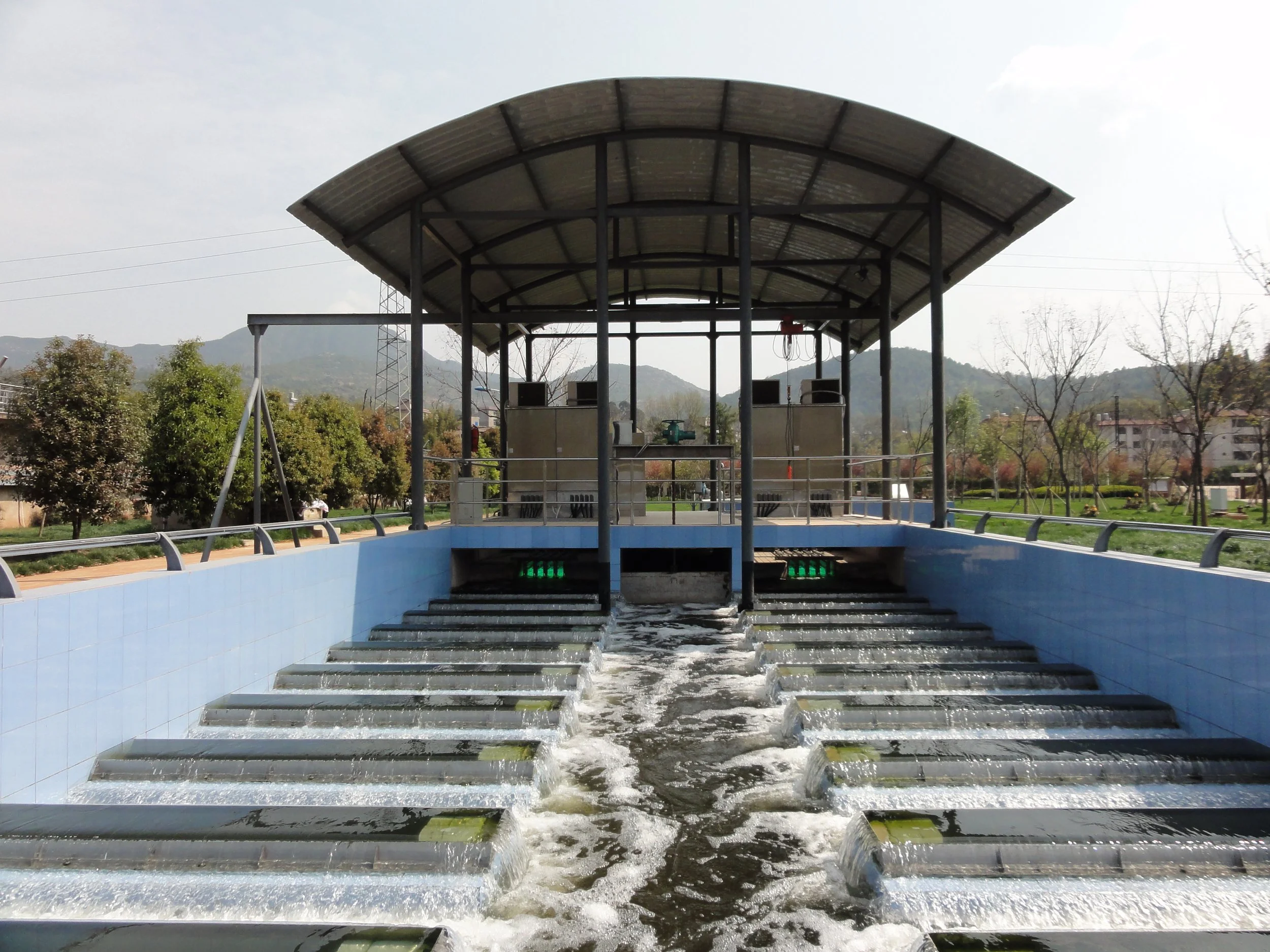
Horizontal Modular Architecture
The horizontal arrangement provides a flexible configuration for open channels and facilitates access to lamps, quartz sleeves and cleaning components during inspection and maintenance.
Depending on project requirements, modules can be arranged in multiple banks and configurations to provide the required treatment capacity, redundancy and hydraulic operating window.
Typical materials are:
SS316 / SS316L for submerged components
SS304 for components located above water
Final material selection can be upgraded according to the water characteristics, corrosion environment and project specification.
Automatic Quartz-Sleeve Cleaning
Fouling of quartz sleeves reduces the UV energy transmitted into the water. For this reason, NLQ-H incorporates an automatic pneumatic mechanical cleaning system that periodically moves wiping elements along the quartz sleeves.
Cleaning frequency can be adjusted according to water quality, UVT, suspended solids and fouling tendency.
Mechanical cleaning is the standard configuration, while chemical-assisted cleaning can also be incorporated in selected NLQ-H configurations when required by the application.
This allows sleeve cleanliness to be maintained without routinely removing UV modules from service for manual cleaning.
Intelligent Dose Pacing
NLQ-H supports automatic lamp-power regulation to adapt UV output to changing treatment conditions.
The control system can modulate lamp power typically within a 50–100 % operating range, using signals such as:
Plant flow rate
UVT, when an online UVT sensor is included
Operating status and system demand
This allows the system to reduce lamp power when treatment conditions are favourable while increasing output when the required UV duty rises.
The objective is to maintain the required disinfection performance while avoiding unnecessary operation at full electrical power.
Monitoring & Control
Depending on project configuration, the NLQ-H system can include:
UV intensity monitoring
Ultrasonic channel-level measurement
Lamp status and operating-hour monitoring
Automatic cleaning-cycle management
PLC + HMI control
Alarm and interlock management
4–20 mA signals
Modbus TCP/RTU and other project-specific communications
SCADA integration
The ultrasonic level sensor also provides an important protective function by monitoring correct lamp submergence and allowing the UV system to react to abnormal water-level conditions.
Hydraulic Integration
The final NLQ-H arrangement is developed together with the channel hydraulics.
Longking evaluates parameters including:
Channel width and water depth
Minimum and maximum flow
Allowable hydraulic head loss
Lamp submergence
Bank spacing and module arrangement
Flow distribution
Fixed weir or motorized level-control requirements
Maintenance and lifting access
This makes NLQ-H suitable for both new treatment channels and retrofit projects, provided that the hydraulic operating envelope is evaluated during system design.
Typical Applications
NLQ-H is primarily applied in:
Municipal wastewater disinfection
Tertiary treatment and water reuse
Industrial wastewater
Industrial process water
Retrofit of existing open-channel UV installations
Projects requiring a horizontal UV module architecture
NLQ-HPV Series — High-Power Vertical Open-Channel UV Disinfection
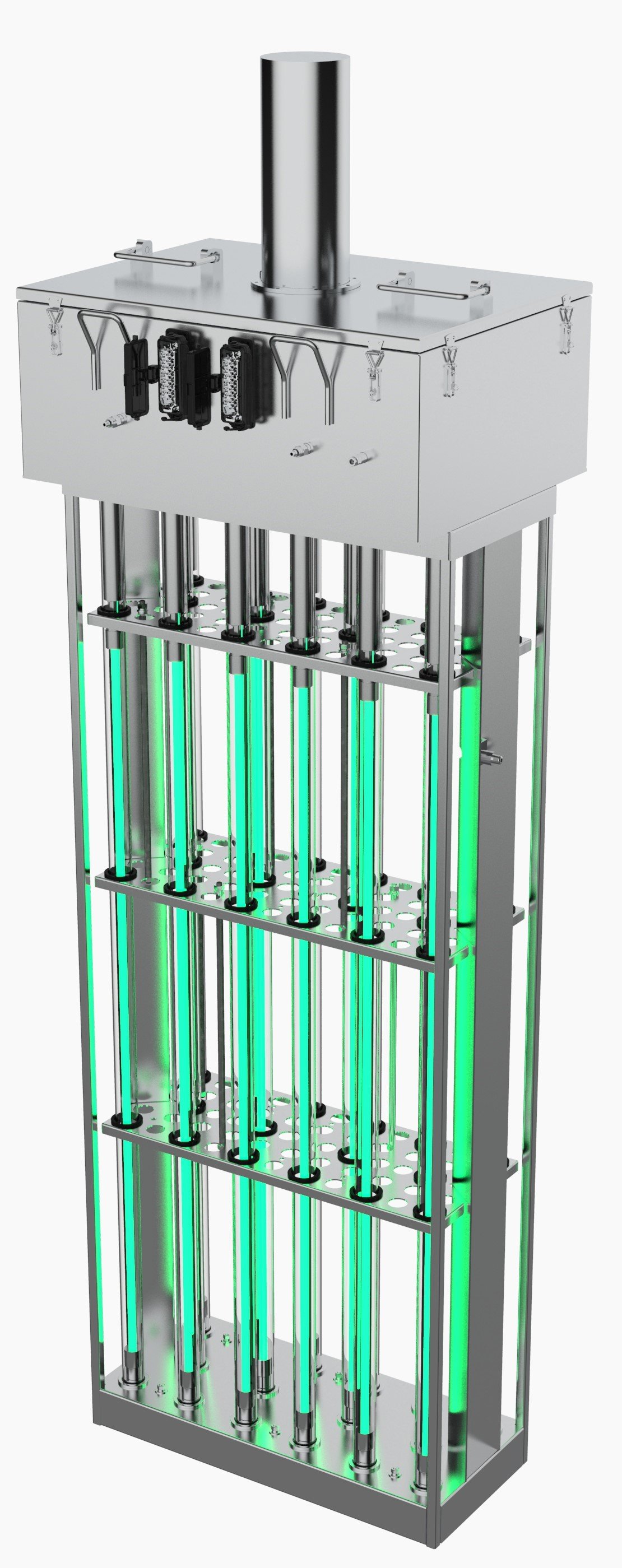
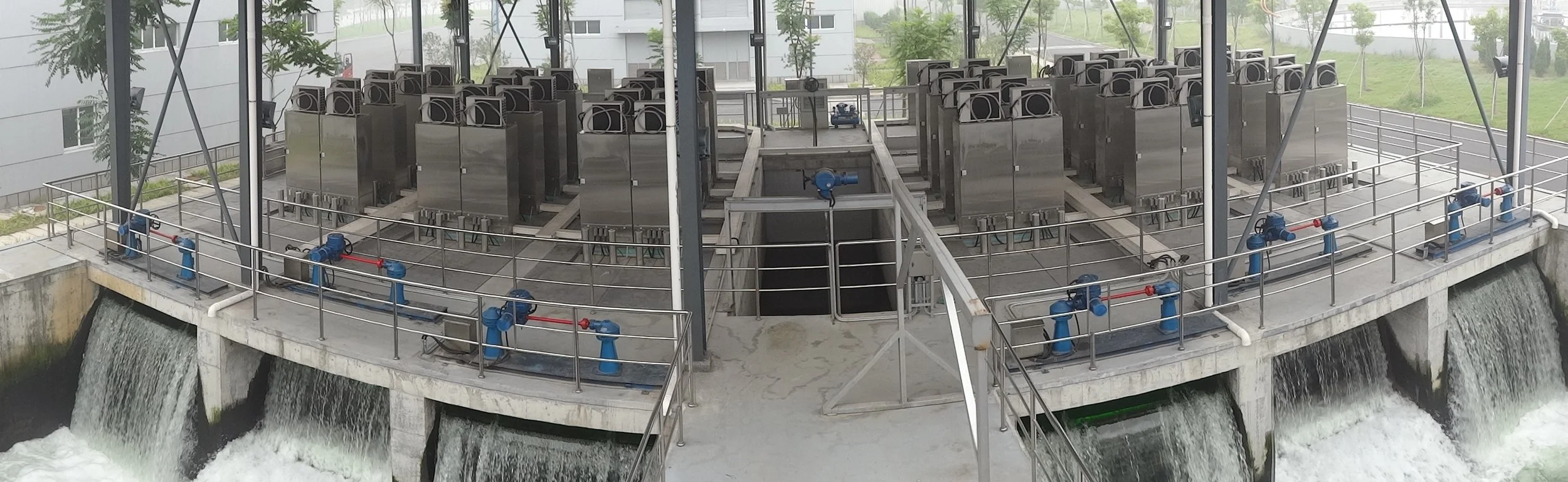
The Longking NLQ-HPV Series is a high-capacity open-channel UV disinfection platform based on a vertical lamp architecture and 800 W low-pressure amalgam technology.
Its high installed UV-C power density makes NLQ-HPV particularly suitable for large treatment flows, compact channel layouts and projects where available civil footprint is limited.
Each system is engineered according to the actual flow range, UVT, suspended solids, required UV dose, hydraulic conditions and redundancy philosophy of the project.
800 W High-Power Amalgam Lamp Technology
NLQ-HPV modules use 800 W low-pressure high-intensity amalgam lamps, providing approximately 256 W of UV-C output at 254 nm per lamp.
A standard NLQ-HPV module accommodates 16 lamps, providing a high installed UV-C capacity within a compact vertical module architecture.
Current lamp specifications include:
800 W nominal electrical power
256 W UV-C output at 254 nm
Low-pressure amalgam technology
12,000-hour guaranteed operating life
Performance criteria of up to 14,000 hours at 80% UV-C output, depending on the applicable lamp and project specification.
This high-power lamp platform allows large UV duties to be achieved with fewer individual lamps than lower-power architectures, depending on the hydraulic and disinfection requirements of the project.
Vertical High-Capacity Architecture
The vertical configuration concentrates a high UV-C capacity within the channel while maintaining a modular arrangement that can be adapted to different plant layouts.
NLQ-HPV is therefore particularly attractive where:
High treatment capacity is required
Available channel width or footprint is constrained
High installed UV-C power density is advantageous
Modular expansion or redundancy is required
Individual module extraction and maintenance access must be considered
Modules can be configured in multiple banks and parallel treatment channels according to the required capacity and operating philosophy.
Typical materials are:
SS316 / SS316L for submerged components
SS304 for non-submerged components and electrical cabinets
with final material selection defined according to project and environmental requirements.
Automatic Quartz-Sleeve Cleaning
NLQ-HPV incorporates an automatic pneumatic mechanical cleaning system designed to limit fouling on the quartz sleeves and maintain UV transmission during operation.
Wiping cycles can be programmed according to the water quality, suspended solids and expected fouling conditions.
The cleaning system operates without requiring routine removal of the UV modules from the channel, helping maintain consistent operating conditions while reducing manual cleaning requirements.
Intelligent Dose Pacing
The NLQ-HPV power system supports automatic regulation of lamp output according to the actual treatment demand.
Lamp power can typically be modulated within a 50–100% operating range, using process signals such as:
Instantaneous flow rate
Online UVT, when included
Operating status and treatment demand
The PLC uses these inputs to adapt lamp power to changing conditions, helping reduce unnecessary electrical consumption while maintaining the required UV treatment objective.
UV Monitoring & Water-Level Control
Depending on project configuration, NLQ-HPV incorporates:
UV intensity monitoring at 254 nm
Ultrasonic water-level measurement
Lamp status and operating-hour monitoring
Cleaning-cycle supervision
PLC + HMI control
Alarm and interlock management
4–20 mA process signals
Industrial communications and SCADA integration
The UV sensor is used for continuous monitoring of UV intensity and system condition, while flow and UVT information can be incorporated into the dose-pacing strategy when required.
The ultrasonic level sensor protects the UV equipment by monitoring correct lamp submergence and enabling alarms or shutdown actions if the channel level moves outside the permitted operating range.
Hydraulic Integration & Level Control
The final NLQ-HPV configuration is developed together with the hydraulic design of the UV channel.
Longking evaluates:
Minimum and maximum flow
Channel width and operating water depth
UVT and suspended solids
Required UV dose and microbiological objective
Allowable head loss
Module and bank arrangement
Flow distribution
Lamp submergence
Fixed weir or motorized level-control requirements
Maintenance and lifting access
A stable water level is particularly important in open-channel UV systems to ensure correct lamp submergence and repeatable hydraulic conditions.
Depending on the project, level control can therefore be provided through a fixed weir or an active motorized regulation system.
Designed for Large & Demanding UV Installations
NLQ-HPV is primarily suited to applications including:
Large municipal wastewater treatment plants
High-capacity tertiary disinfection
Water reuse
Industrial wastewater
Multi-channel UV installations
Plant expansions and phased capacity increases
Projects requiring high UV-C capacity within a compact civil footprint
Its modular architecture also allows duty/standby philosophies and future expansion to be incorporated when required.
UV Performance Validation, Testing & Compliance
UV system performance must be evaluated using clearly defined design conditions and appropriate verification methods.
Longking combines project-specific UV sizing, bioassay-validated solutions, factory testing and conformity documentation to provide traceable technical evidence according to the requirements of each project.
Bioassay-Validated UV Performance
For projects requiring validated UV performance, Longking can provide bioassay-validated UV solutions based on defined hydraulic and water-quality conditions.
Biodosimetric testing evaluates the performance of a UV system using microorganisms with a known UV dose-response relationship, allowing the reactor or channel performance to be related to a delivered or validated UV dose under the tested operating conditions.
This is fundamentally different from calculating UV dose only from nominal lamp power or theoretical intensity.
The applicability of a validation depends on parameters including:
UV system configuration
Lamp type and power
Flow rate
UV transmittance (UVT)
Hydraulic configuration
Lamp operating condition
Fouling and ageing assumptions
Required microbiological performance
For this reason, the validation basis and applicable operating envelope are reviewed project by project when a validated dose is required.
Design Dose vs. Validated Dose
In UV engineering it is important to distinguish between a theoretical or calculated design dose and a validated dose derived from biodosimetric performance testing.
A theoretical calculation can be useful during preliminary sizing, but actual UV performance is also influenced by hydraulics, UVT, lamp arrangement, fouling, ageing and the path followed by microorganisms through the UV field.
Where a project specification requires biodosimetric validation, Longking selects and configures the UV system according to the required validated dose and the applicable validation conditions, rather than relying only on nominal lamp power.
Factory Acceptance Testing (FAT)
Before shipment, project-specific UV systems can undergo a Factory Acceptance Test (FAT) to verify mechanical assembly, electrical operation, instrumentation, automatic cleaning, lamp control, alarms, PLC/HMI functions and communication with higher-level control systems.
Typical FAT activities can include:
Visual and dimensional inspection
Lamp and ballast operation
Flow and level signal simulation
Automatic power regulation
UV sensor verification
Automatic cleaning-system testing
PLC and HMI operation
Alarm and event logging
SCADA communication
Electrical protection and safety functions
FAT therefore verifies that the supplied equipment is correctly assembled, configured and operational before shipment, complementing — but not replacing — UV performance validation.
CE Conformity & Project Documentation
Longking can provide the applicable EU Declaration of Conformity and associated technical documentation.
The documented NLQ-HPV conformity package includes requirements related to the Low Voltage Directive, EMC Directive and Machinery Directive, together with relevant EN/IEC standards for electrical equipment, machinery safety and switchgear assemblies.
Depending on project requirements, the documentation package can also include:
Material certificates
Equipment datasheets
Electrical and control drawings
FAT documentation
Operation and maintenance manuals
Spare-parts documentation
Project-specific conformity and guarantee certificates
Proven UV Experience Worldwide
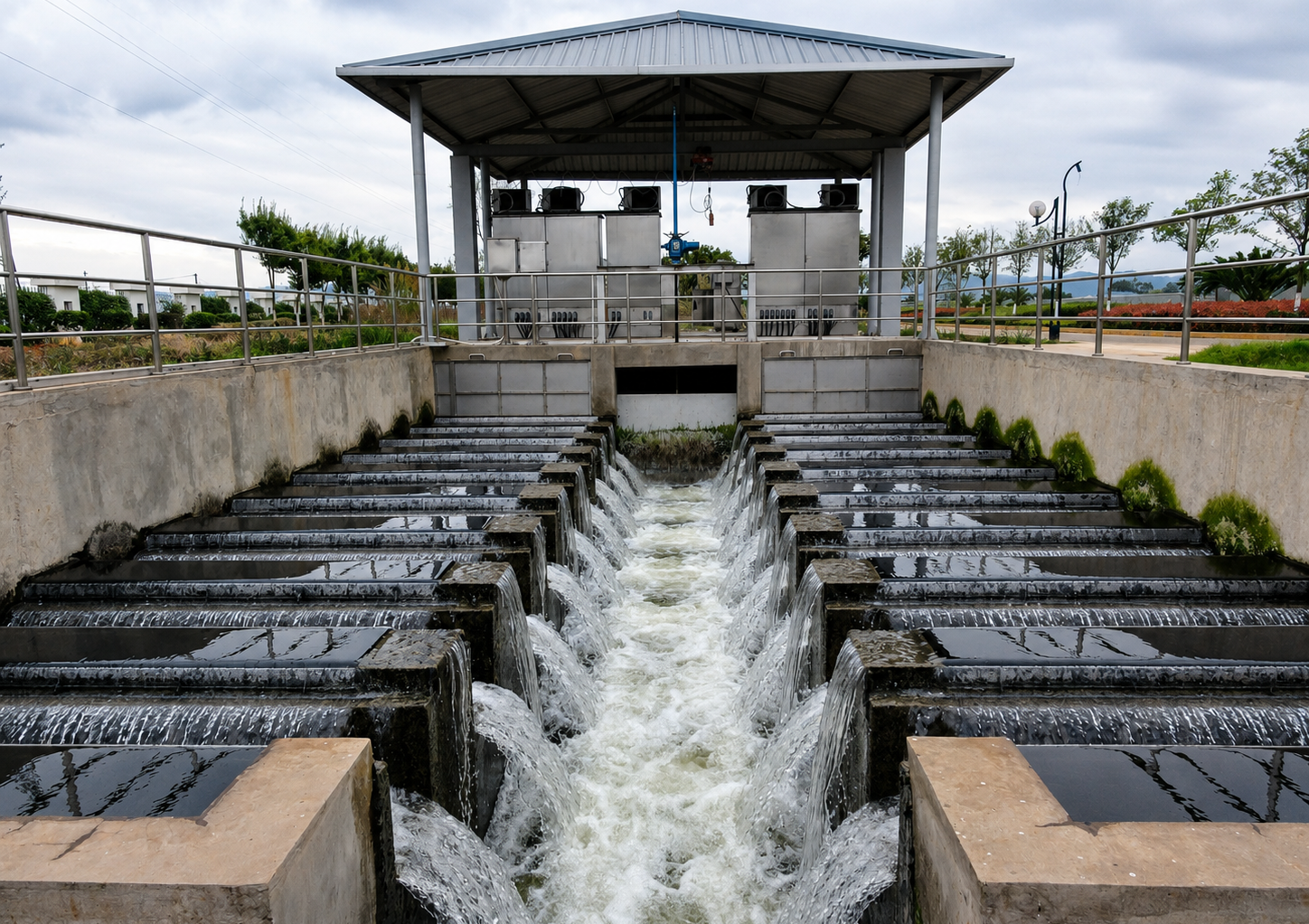
Longking has extensive experience in the design and supply of open-channel UV disinfection systems for municipal and industrial water treatment projects worldwide.
The installed base covers applications ranging from compact treatment systems to large-scale municipal wastewater plants, including tertiary treatment, water reuse, industrial wastewater and capacity-expansion projects.
Experience Across Different Treatment Scales
The modular architecture of the NLQ platform allows UV systems to be engineered for a wide range of treatment capacities and hydraulic configurations.
Longking experience includes:
Small and medium open-channel UV installations
Large municipal wastewater treatment plants
Multi-channel UV systems
Tertiary treatment and water reuse
Industrial wastewater applications
Plant expansions and phased capacity increases
Retrofit of existing UV channels and installations
Each system is nevertheless designed individually according to the actual flow, UVT, suspended solids, required UV dose, hydraulic conditions and redundancy philosophy of the project.
International Project Experience
Longking UV technology has been applied across Europe, Asia, Africa, the Middle East and the Americas, providing experience with different water qualities, design standards, climatic conditions and plant requirements.
This international project base supports Longking's ability to adapt the UV system not only to the required disinfection performance, but also to the civil, hydraulic, electrical, automation and operational requirements of each installation.
From Engineering to Long-Term Operation
Longking supports UV projects throughout the complete project lifecycle, including:
UV sizing and system selection
Hydraulic and channel integration
Mechanical, electrical and control engineering
Factory Acceptance Testing (FAT)
Installation supervision and commissioning
Operator training
Spare parts and lifecycle technical support
Detailed project references and application case studies are available through the Longking Media Center, where selected installations are presented with their specific technical characteristics and project requirements.
Engineering Support for Your UV Project
Longking combines UV process engineering, hydraulic design and project execution experience to develop open-channel disinfection systems adapted to the actual operating conditions of each plant.
From preliminary sizing to commissioning and long-term operation, our engineering team supports municipal and industrial projects throughout the complete UV system lifecycle.
From UV Sizing to Plant Operation
Depending on project requirements, Longking can provide:
UV system sizing and configuration
Hydraulic and channel integration
Mechanical, electrical and automation engineering
Project-specific drawings and technical documentation
Factory Acceptance Testing (FAT)
Installation supervision and commissioning
Operator training
Spare parts and lifecycle technical support
Whether the project involves a new installation, an existing-channel retrofit or a large multi-channel UV plant, the final system is configured around the required flow, UVT, suspended solids, UV dose, hydraulic conditions and operating philosophy.