


Industrial & Municipal Ozone Generators for Water Treatment
High-Efficiency Ozone Generation Systems for Advanced Water Treatment
At Longking EnTech Europe, we design and deliver ozone generation systems and complete ozonation solutions for municipal and industrial water treatment applications.
With more than 25 years of experience in ozone technology, Longking combines advanced corona discharge ozone generation with process engineering, gas preparation, cooling, injection and contact systems, automation and safety to provide complete solutions adapted to each project's operating requirements.
Our ozone systems support applications including drinking water treatment, municipal and industrial wastewater, water reuse, Advanced Oxidation Processes (AOP), food and beverage, aquaculture and other demanding industrial processes.
From compact systems to large-scale municipal and industrial installations, Longking provides modular ozone generation platforms supported by engineering, FAT/SAT, commissioning and lifecycle services.
Why Ozone? — Advanced Oxidation & Disinfection
Ozone (O₃) is a powerful oxidant and disinfectant widely used in drinking water, wastewater and industrial water treatment for applications requiring rapid oxidation and effective microbiological control.
Unlike conventional chemicals that must be transported and stored, ozone is generated on site from air or oxygen and decomposes rapidly after treatment. Its high reactivity makes it particularly suitable for both disinfection and oxidation of selected inorganic and organic compounds.
Key Benefits of Ozone Treatment
High Disinfection Performance: Ozone can provide effective inactivation of bacteria, viruses and other microorganisms, with the required dose and contact conditions determined according to the specific water quality and treatment objective.
Micropollutant Oxidation: Ozone is widely applied for the oxidation of selected pharmaceuticals, pesticides, endocrine-disrupting compounds and other organic micropollutants in advanced water treatment.
Taste, Odour & Colour Control: Ozone can effectively oxidize compounds responsible for taste, odour and colour, including applications involving geosmin and 2-MIB in drinking water.
Improved Biodegradability: Partial oxidation of complex organic matter can generate more biodegradable compounds, supporting downstream biological treatment or BAC processes.
Reduced Chemical Dependency: Ozone generation on site can reduce the use, transport and storage of conventional chemical oxidants and disinfectants, depending on the overall treatment process.
Advanced Oxidation Processes (AOP): Ozone can be combined with H₂O₂, UV or other process configurations to enhance hydroxyl-radical formation when more intensive oxidation is required.
Flexible Integration into Water Treatment Processes
Ozone can be applied at different stages of the treatment process, including:
Pre-ozonation for raw water conditioning, algae control and oxidation of selected metals and organic compounds.
Intermediate ozonation for micropollutant oxidation and integration with GAC/BAC treatment.
Final oxidation and polishing in wastewater and water reuse applications.
Industrial process treatment for specific contaminants, colour, odour and recalcitrant organic compounds.
AOP configurations for more demanding oxidation objectives.
The optimum ozone treatment depends on the water matrix, ozone demand, target compounds, applied dose, contact time and mass-transfer efficiency. For this reason, Longking evaluates each application individually before defining the final ozone generation and treatment system.
Ozone Generator Performance
Longking ozone generators are designed to combine high ozone concentration, low specific energy consumption and stable continuous operation across a wide range of municipal and industrial applications.
Different feed-gas configurations can be selected according to required ozone capacity, target concentration, energy efficiency, site utilities and project economics.
Oxygen Feed — LOX / PSA
For medium and large ozone installations, oxygen-fed generators provide high ozone concentrations with very low specific energy consumption, reducing the gas flow required for a given ozone production and enabling efficient integration into large-scale treatment processes.
Key performance values:
Up to 296 g O₃/Nm³
Ozone concentration with oxygen feed
From 7.5 kWh/kg O₃
Ozone generator specific energy consumption
Oxygen can be supplied from LOX or on-site PSA/VPSA systems, allowing the overall configuration to be optimized according to plant capacity, operating profile and available utilities.
Longking oxygen-fed ozone systems are suitable for applications ranging from conventional water treatment to large-capacity municipal, industrial and advanced oxidation plants requiring continuous and reliable ozone production.
Dry-Air Feed
Longking also offers ozone generation systems based on treated dry-air feed, providing an alternative where an external oxygen supply or dedicated oxygen generation system is not preferred.
Key performance values:
Up to 40 g O₃/Nm³
Ozone concentration with dry-air feed
≤16 kWh/kg O₃
Ozone generator specific energy consumption
Dry-air systems integrate the required air compression, drying and gas preparation to provide the feed-gas quality necessary for stable ozone generation.
This configuration is particularly suitable for small and medium ozone systems and installations where operational independence from external oxygen supply is an advantage.
Performance values depend on generator model, ozone concentration, feed-gas quality, cooling-water conditions and operating point. Maximum ozone concentration and minimum specific energy consumption may correspond to different operating conditions.
The Science of Ozone Generation
High-Frequency Corona Discharge Technology
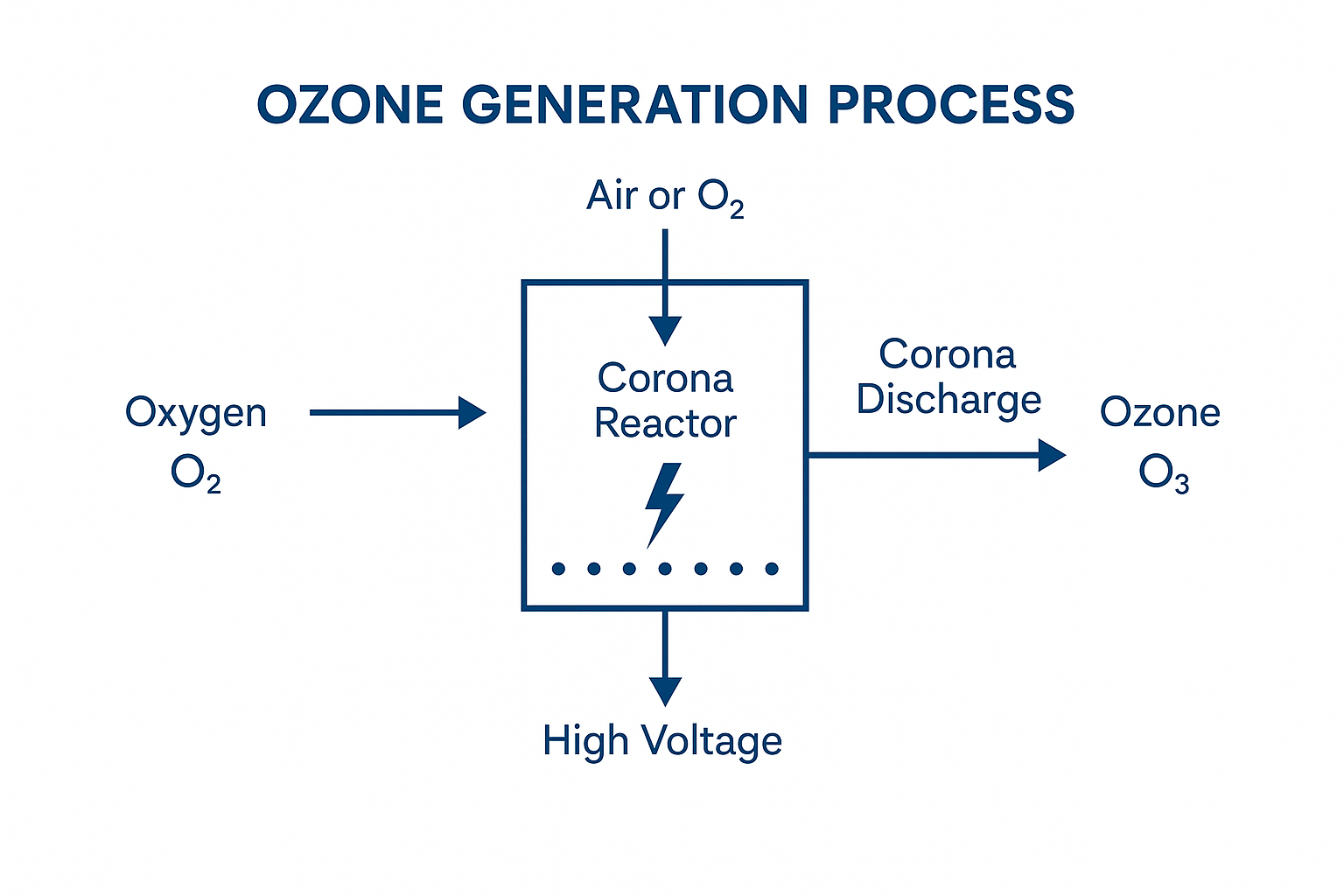
Longking ozone generators use high-frequency corona discharge technology with a double micro-gap discharge design to convert oxygen molecules (O₂) into ozone (O₃).
Inside the generator, the feed gas passes through a precisely controlled discharge gap between the electrodes and dielectric material. A high-frequency electrical field creates a cold plasma, dissociating part of the oxygen molecules into atomic oxygen.
These oxygen atoms subsequently combine with O₂ molecules to form ozone (O₃).
The micro-gap configuration is designed to provide uniform electrical discharge, efficient heat removal and stable ozone generation, supporting high production efficiency under continuous operating conditions.
Advanced Power Electronics & Control
The electrical system combines IGBT power electronics with DSP-based control and Pulse Density Modulation (PDM) to precisely regulate the energy supplied to the discharge.
This allows ozone production to be adjusted according to process demand while maintaining stable operating conditions across the generator's control range.
Integrated control continuously manages and monitors key operating parameters including ozone production, electrical conditions, feed-gas parameters, cooling and system safety signals.
Efficient Thermal Management
Temperature has a direct influence on ozone generation efficiency and ozone decomposition, making effective cooling an essential part of generator performance.
Longking generators incorporate dedicated cooling circuits designed to efficiently remove the heat generated during the discharge process and maintain stable operating conditions.
Cooling requirements are defined according to generator capacity, ozone concentration, feed-gas configuration and site cooling-water conditions.
Engineered for High Ozone Concentration and Low Energy Consumption
The combination of micro-gap discharge geometry, high-frequency power electronics, optimized dielectric design, controlled gas flow and effective cooling enables Longking generators to achieve high ozone concentrations while maintaining competitive specific energy consumption.
Rather than operating at a single fixed condition, the ozone generator can be configured according to the required balance between:
Ozone production capacity
Ozone concentration
Specific energy consumption
Feed-gas flow
Process requirements
Operating redundancy and turndown
This allows the operating point to be optimized for the specific requirements of each project.
More Than an Ozone Generator
A complete ozonation plant requires much more than ozone production alone.
Longking combines ozone generation technology with process engineering and complete system integration, providing the equipment and control required to safely produce, transfer and apply ozone to the treatment process.
Complete Ozone System Integration
Depending on project requirements, the complete solution can include:
LOX, PSA/VPSA or dry-air feed-gas systems
Ozone generators and power supply units
Cooling systems and heat exchangers
Ozone concentration measurement
Injection systems, ejectors or porous diffuser systems
Contact tanks and process hydraulics
Off-gas ozone destruction
Dissolved ozone monitoring
Ambient ozone detection and safety systems
PLC/HMI automation and plant communication
Integration with SCADA/DCS through industrial communication protocols
SENTINEL remote monitoring, when required
Longking engineers each system according to the required ozone dose, water or gas flow, ozone transfer efficiency, treatment objective, process conditions and redundancy philosophy.
From compact ozone units to large multi-generator installations, the objective is to provide an integrated ozone treatment system rather than simply an ozone-producing machine.
Engineering for Large-Scale Ozone Plants
For large municipal and industrial applications, Longking can combine multiple ozone generators into a modular production architecture, providing the required capacity together with operational redundancy and flexible production control.
Generator selection and operating concentration are evaluated according to the actual process requirements. Increasing ozone concentration, for example, may reduce the required feed-gas flow but can also affect the available ozone production and specific energy consumption.
For this reason, Longking evaluates the complete operating envelope of the ozone plant rather than sizing the system around a single nominal performance value.
Two Complementary Ozone Generator Series
Longking offers two complementary ozone generator platforms designed to cover applications ranging from compact treatment systems to large-scale municipal and industrial ozone plants.
Both series are based on Longking's corona discharge technology and are selected according to the required ozone production, feed-gas configuration, installation concept, redundancy and operating requirements.
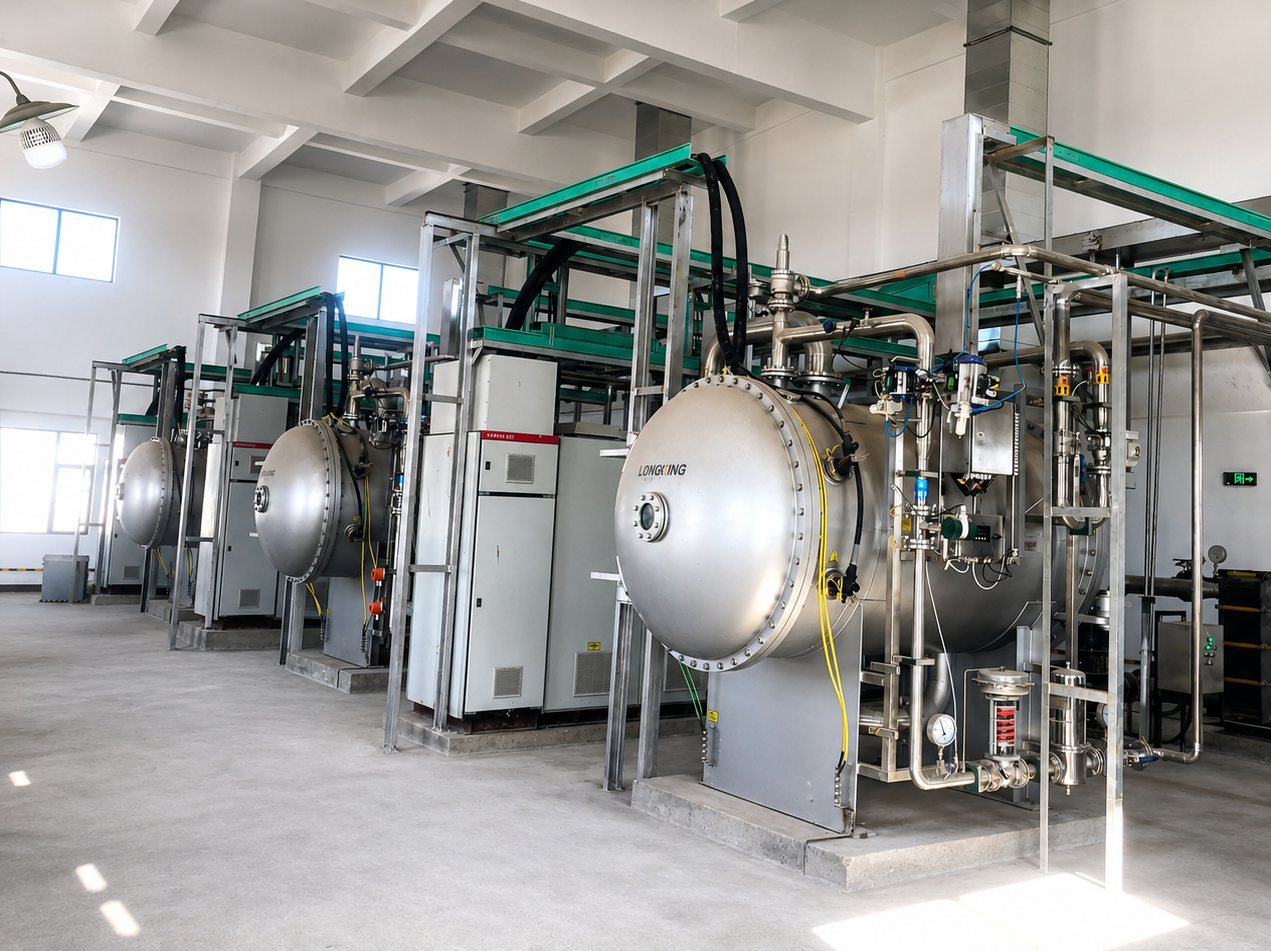
The NLO Series is Longking's modular ozone generation platform for municipal and industrial applications requiring high production capacity, continuous operation and flexible system configuration.
Its modular architecture allows individual generators or multiple units to be combined according to the required plant capacity and redundancy philosophy.
Main characteristics:
Production capacity from 0.2 to 200 kg O₃/h, depending on configuration.
Compatible with dry-air and oxygen feed systems.
High ozone concentrations with oxygen feed, up to 296 g O₃/Nm³.
Specific energy consumption from approximately 7.5 kWh/kg O₃ with oxygen feed, depending on operating conditions.
Double micro-gap corona discharge technology with borosilicate glass dielectric.
High-frequency IGBT power electronics with DSP/PDM control.
Closed-loop water cooling for efficient thermal management.
Integrated PLC/HMI, instrumentation, regulation and safety interlocks.
Modular architecture supporting redundancy, phased expansion and high plant availability.
The NLO Series is particularly suited to drinking water, municipal wastewater, water reuse, industrial wastewater, Advanced Oxidation Processes and other high-capacity ozone applications.
NLO LITE Series — Compact & Integrated Ozone Systems
NLO Series — Modular Ozone Generators for Large-Scale Applications
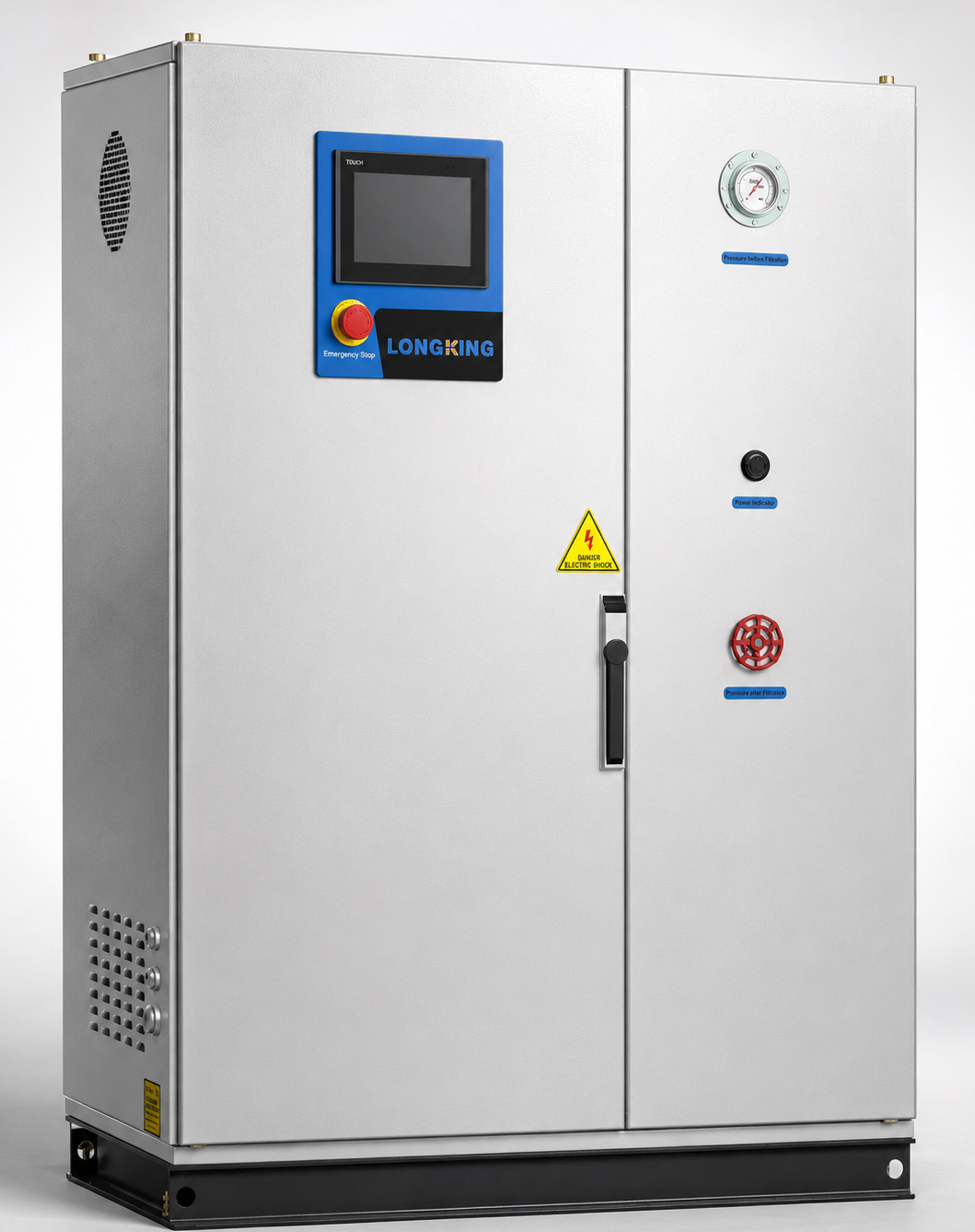
The NLO LITE Series brings Longking ozone technology into a compact platform for applications requiring lower ozone production and space-efficient integration.
With production capacities from 0.5 to 1.5 kg O₃/h, NLO LITE can be configured for oxygen feed from PSA or LOX, or treated dry-air feed, according to project requirements.
Main characteristics:
0.5–1.5 kg O₃/h ozone production range
Oxygen feed from PSA/LOX or treated dry-air feed
Ozone concentrations up to 296 g O₃/Nm³ with oxygen feed
Specific energy consumption ≤8 kWh/kg O₃ with oxygen feed, depending on model and operating conditions
Double micro-gap corona discharge technology
Closed-loop water cooling
Ozone-contact materials including AISI 316L and PTFE
Integrated PLC-based control with optional HMI
Ethernet connectivity for external monitoring and plant-control integration
NLO LITE is suitable for applications including municipal and industrial water treatment, water reuse, aquaculture/RAS, pilot plants and compact ozone-treatment systems, with the final configuration defined according to the required ozone production, feed-gas source and operating conditions.
Advanced Power Electronics — IGBT Technology for Efficient Ozone Generation
Longking ozone generators use high-frequency power supply units based on IGBT technology, combined with digital control to precisely regulate the electrical energy delivered to the ozone discharge.
The converter integrates IGBT (Insulated Gate Bipolar Transistor) modules, DSP (Digital Signal Processor) control and Pulse Density Modulation (PDM) to provide stable and responsive energy regulation across the operating range.
Precise Energy Regulation
The power electronics continuously adjust the energy supplied to the discharge according to the required ozone production while maintaining the selected operating conditions.
Combined with Longking's control philosophy, this supports stable ozone concentration and optimized specific energy consumption, even when plant ozone demand varies.
Integrated Protection & Diagnostics
The electrical and discharge system incorporates multiple protection and diagnostic functions, including:
Converter diagnostics
Electronic detection of abnormal dielectric conditions
Individual dielectric protection through UFF fuse technology
Automatic monitoring of relevant electrical and operating parameters
Protection and shutdown logic in the event of abnormal operating conditions
These functions help isolate individual faults and protect the generator while supporting reliable continuous operation.
Reduced Auxiliary Cooling Requirements
The high-frequency converter design is optimized for efficient operation and does not require dedicated air conditioning in most generator configurations.
Final cooling requirements are nevertheless defined according to the generator model, installed electrical equipment, ambient conditions and project configuration.
Automation & Control — Intelligent Ozone Plant Operation
Longking ozone systems incorporate PLC-based automation and local HMI control to continuously monitor operating conditions, regulate ozone production and manage the safety logic of the system.
The control architecture can be adapted to the requirements of each project, from stand-alone ozone generators to complete multi-generator plants integrated with the customer's SCADA or DCS.
Automatic Process Control
The control system manages and monitors the main operating parameters of the ozone installation, including:
Ozone production and concentration
Feed-gas flow and pressure
Cooling-water conditions
Generator electrical parameters
Equipment status and safety interlocks
Process alarms and operating history
Ozone production can be automatically adjusted according to the required process demand, helping maintain stable operating conditions while optimizing energy and feed-gas consumption.
PLC, HMI & Plant Integration
Longking systems include local PLC control and HMI visualization, allowing operators to monitor equipment status, process parameters, alarms and operating conditions in real time.
Depending on project requirements, the ozone plant can be integrated with the customer's control system through industrial communication networks and protocols, enabling centralized supervision and exchange of operating signals.
Control philosophy, I/O architecture, communications and access levels are defined according to the plant automation standards and project specifications.
SENTINEL Remote Monitoring
SENTINEL is Longking's optional remote assistance and monitoring platform, providing secure access to the ozone plant control system for operational support and troubleshooting.
Depending on system configuration, SENTINEL can support:
Remote monitoring of operating parameters
Data logging and alarm follow-up
Remote PLC diagnostics and programming support
Remote HMI visualization and assistance
Commissioning and troubleshooting support
Performance follow-up to support preventive maintenance
This allows Longking's technical team to assist plant operators remotely, reducing response times and supporting long-term system availability.
Modular Architecture, Pre-Assembly & Site Integration
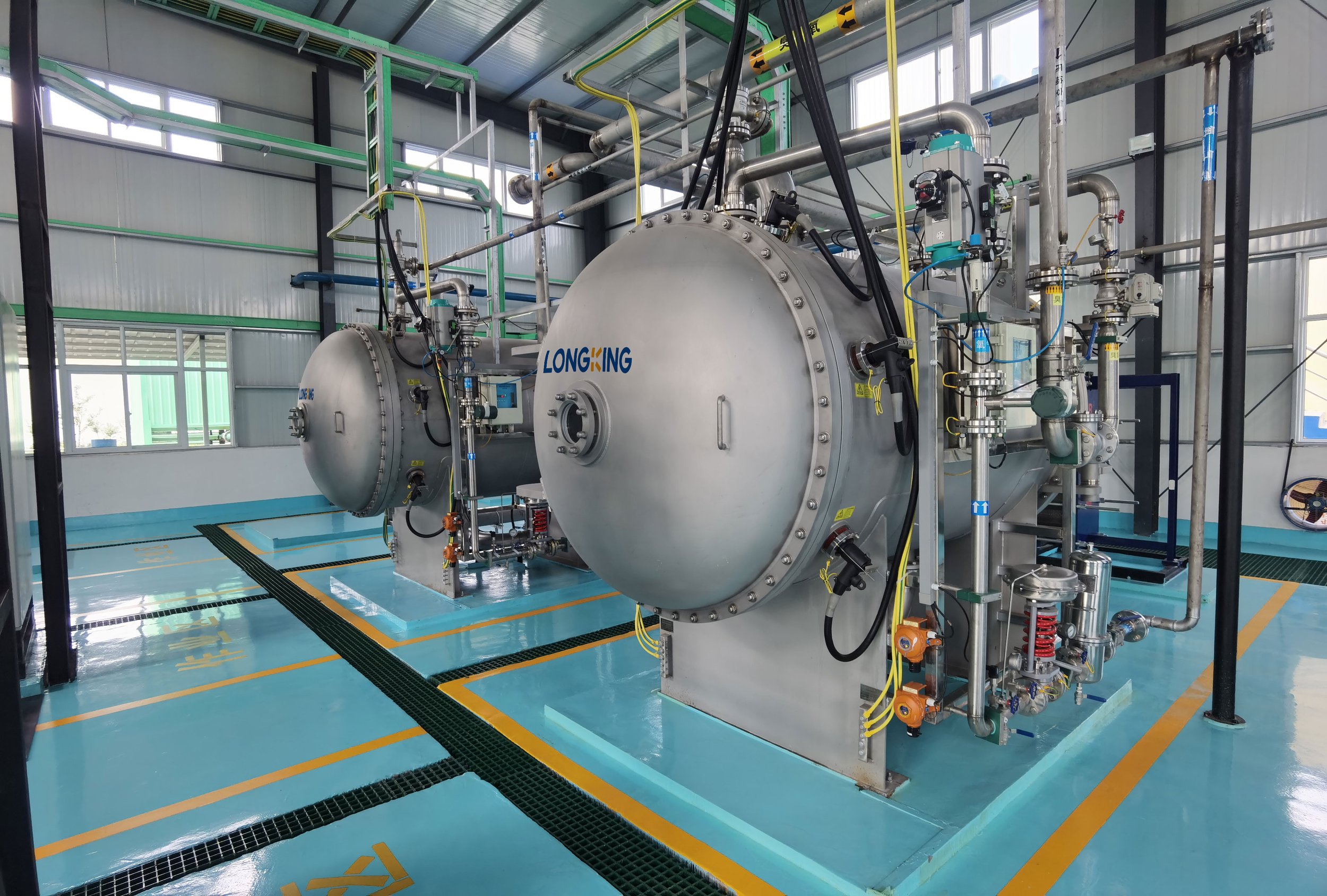
Longking ozone systems can be configured as compact skid-mounted units or modular multi-equipment plants, depending on ozone capacity, redundancy requirements, available space and project-specific installation conditions.
Rather than imposing a single standard layout, the system architecture is adapted to the treatment process, plant utilities, hydraulic configuration, maintenance requirements and site constraints.
Factory Pre-Assembly & Testing
Where practical, the main equipment is pre-assembled and factory-tested before shipment, helping reduce installation work and commissioning time on site.
Depending on the project configuration, pre-assembled equipment can include:
Ozone generator and associated instrumentation
High-frequency power supply units
Local electrical and control panels
Closed-loop cooling skids
Gas regulation and measurement assemblies
Instrumentation and safety devices
Longking combines dedicated testing capabilities with FAT procedures to verify equipment operation, control functions and project-specific requirements before shipment.
Flexible Plant Layout
Large ozone installations frequently require the integration of several independent systems rather than a single skid.
Longking develops the plant arrangement considering:
Generator accessibility and maintenance space
Feed-gas distribution
Cooling-system layout
Ozone piping and distribution
Injection or diffusion systems
Contact tanks and off-gas collection
Ozone destruction
Instrumentation and safety systems
Electrical and control architecture
The layout can therefore be adapted to new installations, existing buildings, plant upgrades and retrofit projects.
Designed for Efficient Site Integration
Mechanical, electrical and control interfaces are defined during engineering to coordinate the ozone system with the overall treatment plant.
Equipment pre-assembly, modular design and clearly defined interfaces help reduce site installation complexity and facilitate commissioning, while allowing the final architecture to remain flexible enough for large and technically demanding projects.
Safety, Reliability & Long-Term Operation
Safety and reliability are fundamental in ozone generation. Longking systems combine generator-level protection, process monitoring and plant safety engineering to support reliable continuous operation in municipal and industrial installations.
The final safety architecture is defined according to the ozone capacity, feed gas, installation environment, applicable regulations and project-specific risk assessment.
Generator Protection
Longking ozone generators incorporate multiple protection and diagnostic functions designed to protect the discharge system and electrical equipment.
Key features include:
Individual dielectric protection with UFF fuse technology
Electronic detection of abnormal or damaged dielectric conditions
Converter diagnostics and electrical protection
Monitoring of gas flow, pressure and operating conditions
Cooling-water temperature and flow monitoring
Automatic alarm and shutdown logic when operating conditions move outside permitted limits
The individual dielectric protection concept allows an affected discharge element to be isolated while helping protect the remaining generator components.
Ozone Plant Safety
A complete ozone installation requires additional safety measures beyond the generator itself.
Depending on project configuration, Longking ozone plants can incorporate:
Ambient ozone detection
Oxygen monitoring where required
Automatic ventilation or emergency extraction
Alarm and automatic shutdown sequences
Off-gas collection and ozone destruction
Under- and over-pressure protection
Safety interlocks between gas preparation, ozone generation, cooling and treatment systems
Integration of safety signals with the plant PLC, SCADA or DCS
Residual ozone collected from contact systems can be routed to thermal or catalytic ozone destruction units before the treated gas is safely discharged.
Materials & Continuous Operation
Components exposed to ozone are selected using ozone-resistant materials, including AISI 316L stainless steel and suitable PTFE or other compatible sealing materials depending on the application.
Longking's horizontal generator architecture also facilitates access to dielectric assemblies for inspection, cleaning and maintenance, while dedicated cooling and instrumentation help maintain stable operating conditions over long operating periods.
For critical installations, modular generator configurations can incorporate equipment redundancy and independent production units, allowing the plant architecture to be adapted to the required availability philosophy.
Compliance & Project-Specific Safety Engineering
Longking ozone systems are engineered according to the applicable electrical, mechanical and pressure-equipment requirements of each project and destination market.
Where applicable, generator pressure components and electrical equipment are designed in accordance with relevant PED and CE requirements, while additional client, HSE or site-specific standards can be incorporated during project engineering.
Applications of Longking Ozone Systems
Longking ozone generation systems are engineered for a wide range of municipal and industrial treatment applications, from compact process installations to large-scale ozone plants.
The final configuration is selected according to the treatment objective, water or gas characteristics, required ozone dose, operating conditions and plant capacity.
Drinking Water Treatment
Ozone is widely applied in drinking water plants for pre-oxidation, taste and odour control, micropollutant treatment, oxidation of selected inorganic compounds and integration with GAC/BAC processes.
→ Explore Municipal Water Treatment
Wastewater Treatment & Water Reuse
Ozone can be integrated into advanced wastewater treatment for micropollutant oxidation, effluent polishing, colour removal, improved biodegradability and water reuse applications.
→ Explore Municipal Water Treatment
Industrial Water & Wastewater
Industrial ozone systems can be adapted to process water, wastewater and reuse applications in sectors including pulp & paper, chemical and petrochemical industries, food & beverage, pharmaceutical production and other industrial processes.
→ Explore Industrial Applications
Advanced Oxidation Processes (AOP)
For demanding oxidation objectives, ozone can be combined with H₂O₂, UV or other process configurations to enhance hydroxyl-radical formation and treat selected compounds that require more intensive oxidation.
→ Explore Ozone & UV Applications
Aquaculture & RAS
Ozone is used together with filtration and UV in aquaculture and recirculating aquaculture systems to support organic matter control, water clarity, UV transmittance and overall water-quality management.
→ Explore Industrial Applications
Industrial Gas Treatment
Longking also applies large-scale ozone generation technology to selected industrial gas-treatment processes, including NOx oxidation and odour-control applications, supported by extensive experience in heavy industrial installations.
→ Explore Industrial Applications
Partner with Longking for Your Ozone Project
With more than 25 years of experience in ozone technology, Longking combines specialized process engineering with the manufacturing, R&D and industrial capabilities of the Longking Group to deliver ozone systems for municipal and industrial projects worldwide.
Our support can cover the complete project lifecycle, from initial process evaluation to commissioning and long-term operation.
From Concept to Operation
Depending on project requirements, Longking can provide:
Process evaluation, feasibility studies and pilot testing
Ozone system sizing and process engineering
Mechanical, electrical and control-system integration
Project-specific equipment design and layout
Factory Acceptance Testing (FAT)
Installation supervision, SAT and commissioning
Operator training and technical documentation
Spare parts and lifecycle support
Remote technical assistance and SENTINEL monitoring, when required
Whether the project requires a compact ozone system or a large multi-generator installation, our engineering team develops the solution around the actual treatment objective, operating conditions and plant requirements.
Contact our engineering team for customized ozone systems that combine efficiency, safety, and innovation.
Products


