

Introducing the NLQ-HPV high-power UV disinfection system
Longking EnTech Europe expanded its ultraviolet disinfection portfolio with the introduction of the NLQ-HPV Series, a high-power vertical open-channel UV system developed for municipal wastewater treatment, tertiary disinfection and water reuse applications.
The NLQ-HPV platform incorporates 800 W low-pressure amalgam UV lamps, combining high germicidal UV-C output with a modular vertical configuration designed for large treatment flows and demanding installation conditions.
Each reference module incorporates 16 UV lamps, providing 12.8 kW of installed electrical lamp power. The system integrates automatic quartz sleeve cleaning, UV intensity monitoring, lamp power regulation and PLC-based automation.
What makes the NLQ-HPV Series different?
Compared with conventional open-channel UV configurations using lower-power lamps, the NLQ-HPV Series provides an alternative engineering approach for installations requiring high UV treatment capacity.
Its high-power lamp technology may allow engineers to optimize the number and arrangement of UV modules, maintenance accessibility and installation footprint, depending on the hydraulic conditions and required disinfection performance.
The selection of NLQ-HPV must nevertheless be based on the actual treatment requirements, including design flow, UV transmittance (UVT), suspended solids, required microbial reduction and available channel dimensions.
The objective is not simply to install more powerful UV lamps, but to achieve reliable disinfection through an appropriate combination of UV-C output, hydraulic design, automatic cleaning and operational control.
With the introduction of NLQ-HPV, Longking EnTech Europe strengthened its open-channel UV portfolio with a high-power platform for new wastewater treatment installations and the modernization of existing UV systems, subject to technical and hydraulic feasibility.
How do vertical UV modules improve open-channel disinfection system design?
The Longking NLQ-HPV Series uses vertically arranged UV lamps installed in modular structures directly within open channels, providing a high-power disinfection configuration for municipal wastewater treatment and water reuse applications.
The vertical arrangement allows engineers to evaluate different module layouts according to the available channel width, water depth, flow conditions and required UV disinfection performance.
This architecture is particularly relevant for large treatment plants where the integration of high UV-C output, hydraulic compatibility and maintenance accessibility must be considered together.
Vertical UV modules and hydraulic integration
In an open-channel UV system, effective disinfection depends on the UV radiation field and the hydraulic exposure experienced by the water as it passes through the irradiation zone.
For this reason, the position and arrangement of NLQ-HPV modules must be selected according to:
Channel width and available installation length.
Minimum and maximum operating water levels.
Design flow and hydraulic velocity.
Flow distribution and potential short-circuiting.
Hydraulic head loss and available upstream water level.
Required UV disinfection performance.
The vertical configuration offers flexibility in module positioning, but uniform hydraulic distribution and adequate UV exposure must be verified through project-specific engineering.
Where necessary, the design may incorporate hydraulic adjustments, flow-distribution measures or water-level control equipment to achieve suitable operating conditions.
Maintenance access and operational reliability
The vertical module arrangement can facilitate access to UV equipment from above the channel, provided that sufficient working space and appropriate lifting arrangements are available.
This can support routine inspection, lamp replacement and maintenance activities without requiring extensive modifications to the surrounding civil infrastructure.
The NLQ-HPV platform also incorporates automatic quartz sleeve cleaning and UV intensity monitoring to support stable operation and reduce the need for frequent manual intervention.
Maintenance procedures and installation accessibility must nevertheless be assessed for each project, particularly where existing channels have restricted access or limited shutdown opportunities.
A modular architecture for large wastewater treatment plants
By combining high-power 800 W UV lamps with vertically arranged modules, the NLQ-HPV Series provides an engineering alternative for large wastewater treatment installations.
Its suitability depends on the interaction between UV output, hydraulic conditions, module arrangement and the required disinfection performance.
The objective is to develop a configuration that delivers reliable UV disinfection while making effective use of the available channel geometry and maintenance space.
How does the NLQ-HPV modular design support high-flow UV disinfection?
The Longking NLQ-HPV Series combines high-power UV lamp technology with a modular vertical architecture, allowing engineers to develop open-channel disinfection systems for different treatment capacities and installation requirements.
Rather than relying on a fixed UV configuration for every project, the system can be engineered by selecting the appropriate number and arrangement of modules according to the required treatment performance and hydraulic conditions.
This approach is particularly relevant for large municipal wastewater treatment plants, where disinfection capacity, channel geometry, energy management and maintenance accessibility must be evaluated together.
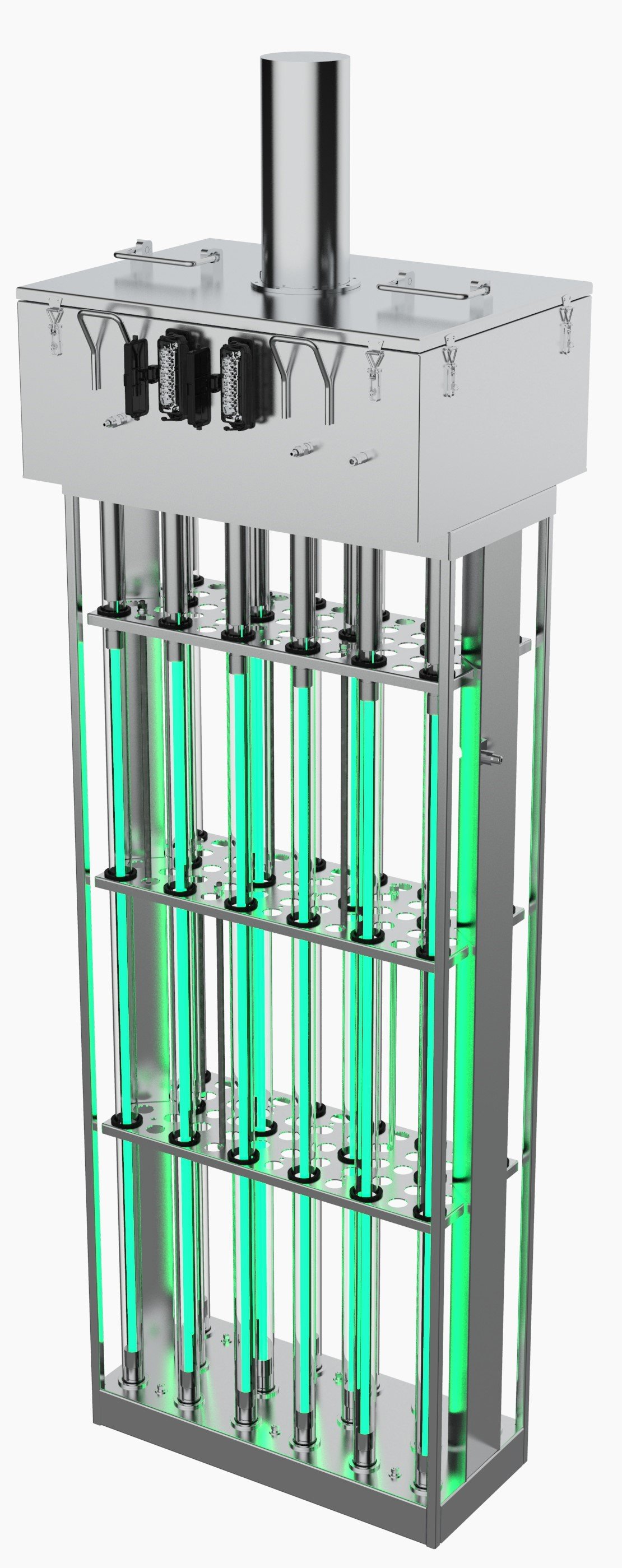
16 high-power UV lamps per module
The reference NLQ-HPV module incorporates:
16 low-pressure amalgam UV lamps.
800 W nominal electrical power per lamp.
12.8 kW total installed lamp power per module.
Vertical lamp arrangement for open-channel installation.
Automatic quartz sleeve cleaning.
UV intensity monitoring and integration with the system control architecture.
Stainless steel construction with materials selected according to immersed and non-immersed operating conditions.
This configuration concentrates substantial UV lamp power within a single modular assembly, providing an alternative to systems based on a larger number of lower-power lamps.
However, installed electrical power is not equivalent to delivered UV dose. The disinfection capacity of each configuration must be evaluated according to UV-C output, water quality, hydraulic conditions and the required microbiological performance.
Modular configurations for different treatment capacities
NLQ-HPV modules can be arranged within an open-channel UV installation according to the specific requirements of the treatment plant.
Depending on the hydraulic design, the system may incorporate multiple UV modules along a treatment channel or distribute the required treatment capacity across parallel channels.
The number and arrangement of modules must be established considering:
Maximum and nominal design flow.
UV transmittance (UVT) at 254 nm.
Suspended solids concentration.
Required UV disinfection performance.
Channel width, depth and operating water levels.
Available installation length and hydraulic head.
Maintenance and lifting requirements.
Operating redundancy and plant availability.
The resulting configuration should balance installed UV capacity, effective exposure conditions and practical operation.
Can NLQ-HPV installations be expanded in the future?
A modular UV architecture can facilitate the evaluation of future capacity increases, particularly when the possibility of expansion is considered during the initial engineering stage.
Potential expansion strategies may include additional UV modules, additional treatment channels or modifications to the operating configuration.
However, expansion is not automatic. Any increase in treatment capacity requires verification of the available hydraulic space, electrical infrastructure, automation architecture and disinfection performance.
Where future capacity growth is anticipated, these requirements should be considered during the initial design to avoid unnecessary modifications later.
Why is modularity important for large wastewater treatment plants?
For large treatment facilities, modularity is not simply a matter of installing more lamps.
It allows engineers to evaluate different configurations while considering treatment performance, accessibility, operating flexibility and lifecycle requirements.
By combining 800 W UV lamps, 16-lamp modules and a vertical open-channel arrangement, the NLQ-HPV Series provides a configurable platform for high-capacity wastewater disinfection projects.
The objective is to select the most appropriate module configuration for each installation, rather than assuming that the highest installed lamp power automatically provides the best technical or economic solution.
How does automatic quartz sleeve cleaning support reliable UV disinfection?
The Longking NLQ-HPV Series incorporates an automatic mechanical cleaning system designed to limit the accumulation of deposits on the quartz sleeves protecting the UV lamps.
In municipal wastewater treatment, quartz fouling can progressively reduce the amount of UV-C radiation transmitted into the water, affecting disinfection performance even when the lamps continue operating normally.
Maintaining clean quartz sleeves is therefore an important part of reliable UV operation and preventive maintenance.
Chemical-free mechanical cleaning with pneumatic actuation
The standard NLQ-HPV cleaning system uses mechanically operated wiping rings that move along the quartz sleeves to remove accumulated deposits.
The cleaning mechanism is pneumatically actuated and can operate automatically according to the configured cleaning sequence.
Its main characteristics include:
Mechanical cleaning without chemical reagents during standard automatic wiping cycles.
Pneumatically actuated wiping mechanisms.
Programmable cleaning sequences controlled through the UV system automation.
Integration with the PLC and HMI for operation and monitoring.
Cleaning operation without routinely removing the UV modules from the channel.
Reduced dependence on frequent manual quartz sleeve cleaning.
The system requires a suitable compressed-air supply for pneumatic actuation.
Because the standard wiping process does not require chemical cleaning solutions, it avoids the routine handling and dosing of cleaning reagents during automatic operation.
However, the cleaning system must still be maintained, and additional manual inspection or cleaning may be necessary depending on water quality and the type of deposits present.
UV intensity monitoring and quartz sleeve condition
The NLQ-HPV system incorporates UV intensity monitoring to support operational supervision and detect changes in the UV radiation measured by the sensors.
UV intensity measurements can help identify operating deviations associated with factors such as:
Quartz sleeve fouling.
Lamp ageing or reduced UV-C output.
Changes in water UV transmittance.
Abnormal lamp or electrical operating conditions.
The control system can use these signals for monitoring, alarms and maintenance support.
However, UV intensity measurement is not equivalent to directly measuring the UV dose delivered to microorganisms.
Reliable disinfection performance requires appropriate UV sizing, suitable hydraulic conditions and operation within the applicable design or validation limits.
Why is automatic cleaning important for lifecycle performance?
In large wastewater treatment plants, cleaning and maintenance requirements can have a significant impact on operating costs and equipment availability.
An automatic mechanical cleaning system can help operators:
Maintain better quartz sleeve cleanliness between maintenance interventions.
Reduce the frequency of manual cleaning.
Limit operational disruption associated with cleaning activities.
Monitor cleaning-system operation through the PLC/HMI.
Support more consistent UV operating conditions.
Actual maintenance savings depend on wastewater characteristics, fouling behaviour, operating hours and maintenance practices.
By integrating automatic mechanical cleaning, UV intensity monitoring and modular equipment design, the NLQ-HPV Series provides a practical approach to maintaining UV system performance throughout its operating life.
How does intelligent power control improve NLQ-HPV energy efficiency?
Energy consumption is an important operating cost in large municipal wastewater UV disinfection systems, particularly in plants operating continuously with significant variations in flow and water quality.
The Longking NLQ-HPV Series incorporates automatic lamp power regulation, allowing the UV system to adapt its electrical consumption to the treatment conditions and the configured disinfection control strategy.
Rather than operating continuously at maximum lamp power, the system can adjust its output when operating conditions permit, helping to optimize energy consumption while maintaining the required disinfection performance.
Automatic UV lamp power regulation and dose pacing
The NLQ-HPV control system uses PLC-based automation to manage lamp operation and monitor relevant operating parameters.
Depending on the project configuration and available instrumentation, the control strategy can consider:
Water flow: Adjusting lamp operation to variations in the treated water flow.
UV transmittance (UVT): Incorporating online UVT measurements where the corresponding analyzer is installed.
UV intensity: Monitoring the radiation measured by the installed UV sensors.
Lamp operating conditions: Considering lamp status, operating power and relevant ageing assumptions.
Operating limits: Maintaining the required safety interlocks and disinfection control conditions.
This approach, commonly referred to as UV dose pacing, can reduce unnecessary electrical consumption during favourable operating conditions, such as periods of reduced flow or higher UV transmittance.
However, the control strategy must be established according to the selected equipment and applicable disinfection requirements.
UV intensity is a measured parameter, whereas the UV dose delivered to microorganisms depends on several factors, including the radiation field, hydraulic conditions and exposure time. It should not be presented as directly measured by the UV intensity sensor alone.
Do 800 W UV lamps automatically reduce energy consumption?
Not necessarily.
The NLQ-HPV Series uses high-power 800 W low-pressure amalgam lamps, providing substantial UV-C output within a modular vertical arrangement.
This configuration may allow engineers to optimize the number and arrangement of UV lamps compared with alternative lower-power configurations.
Nevertheless, a higher-power UV lamp is not automatically more energy-efficient at system level.
A meaningful comparison between 800 W and 320 W UV technologies should consider:
Required disinfection performance under identical design conditions.
UV-C output and efficiency of the selected lamps.
Number of lamps and modules required.
Ballast and auxiliary electrical consumption.
Hydraulic exposure conditions.
Minimum and maximum operating power.
Control strategy and annual operating profile.
Lamp ageing and quartz sleeve fouling assumptions.
The objective is to identify the configuration that meets the required treatment performance with an appropriate balance between electrical consumption, equipment investment and operational requirements.
How can power regulation reduce annual operating costs?
Wastewater flow and UV transmittance can vary throughout the day and across seasons.
When the operating conditions are favourable, automatic power regulation can reduce lamp power instead of maintaining continuous operation at the maximum electrical load.
This creates opportunities to optimize energy consumption over the system's operating life.
However, annual energy savings should be evaluated using representative operating data rather than calculated solely from the installed nominal power.
Relevant indicators include:
Total annual electrical consumption in kWh/year.
Specific energy consumption in kWh/m³ treated.
Expected flow and UVT distribution over the year.
Operating hours at different lamp power levels.
Auxiliary equipment consumption.
Applicable minimum power and disinfection control limits.
These indicators allow engineering teams to compare different UV configurations on a more realistic basis.
Lifecycle OPEX: more than electrical consumption
The operating cost of an open-channel UV system also depends on maintenance, consumables and equipment availability.
For NLQ-HPV, relevant considerations include:
Lamp replacement intervals and applicable performance guarantees.
Number of lamps and ballasts requiring maintenance.
Automatic quartz sleeve cleaning.
Compressed-air consumption for pneumatic cleaning.
UV sensor inspection and calibration.
Spare parts and maintenance accessibility.
Unplanned downtime and associated operational costs.
A configuration using fewer higher-power lamps may reduce the number of individual components requiring maintenance, but this must be confirmed through the actual system design.
The most appropriate UV system is not necessarily the one with the fewest lamps or the lowest nominal installed power. It is the configuration that provides the required disinfection performance with competitive energy consumption, maintenance requirements and total lifecycle cost.
By combining 800 W amalgam lamps, modular vertical design, automatic cleaning and PLC-based power regulation, the Longking NLQ-HPV Series offers an engineering platform for evaluating energy-efficient UV disinfection solutions in large wastewater treatment plants.
Can NLQ-HPV be installed in existing chlorine contact channels?
The Longking NLQ-HPV Series can be considered for both new open-channel UV disinfection installations and the modernization of existing wastewater treatment plants.
One particularly interesting application is the potential conversion of existing chlorine contact channels into UV disinfection channels, allowing utilities to evaluate the reuse of existing civil infrastructure rather than constructing an entirely new disinfection facility.
However, this approach requires a detailed technical assessment. Channels originally designed for chlorine contact are not necessarily suitable for UV disinfection without hydraulic or structural modifications.
Reusing existing chlorine contact infrastructure
Conventional chlorine contact systems are designed to provide sufficient contact conditions between the disinfectant and the treated water.
UV disinfection operates differently. It requires the water to pass through a defined irradiation zone under hydraulic conditions that allow the required UV exposure.
For this reason, reusing existing chlorine contact channels requires verification of:
Channel width, depth and available installation length.
Maximum and minimum operating water levels.
Design flow and hydraulic velocity.
Existing baffles, inlet and outlet arrangements.
Available hydraulic head and allowable head loss.
Space for vertical UV modules and associated support structures.
Access for installation, lifting and maintenance.
Existing electrical supply and automation infrastructure.
UV transmittance (UVT), suspended solids and required disinfection performance.
The existing channels may require modifications to their internal geometry, hydraulic distribution or water-level control system before the new UV equipment can be installed.
What advantages can a chlorine-to-UV retrofit offer?
When the existing infrastructure is technically suitable, conversion to UV disinfection may provide several benefits:
Reuse of civil infrastructure: Existing concrete channels and hydraulic structures can potentially be retained.
Reduced construction requirements: Avoiding the construction of entirely new channels may limit excavation and civil works.
Simplified chemical disinfection operations: UV disinfection does not require chlorine dosing for its own disinfection mechanism.
Reduced chemical handling: Depending on the complete treatment process, chlorine storage and associated handling requirements may be reduced or eliminated.
Modernized process control: UV intensity monitoring, automatic cleaning, lamp power regulation and PLC/SCADA integration can be incorporated.
Potential CAPEX and schedule advantages: Reusing suitable infrastructure may reduce investment and construction time compared with a completely new installation.
These advantages are project-dependent and should be confirmed through technical and economic evaluation.
Can UV completely replace chlorine disinfection?
UV disinfection can provide an effective alternative to chlorine for microbial inactivation when correctly designed and operated.
Unlike chlorine, however, conventional UV disinfection does not provide a persistent disinfectant residual in the treated water.
Whether chlorine can be completely eliminated depends on the application, discharge or reuse requirements and applicable regulations.
In applications requiring a disinfectant residual after UV treatment, an additional disinfection stage may still be necessary.
The conversion must also account for the microorganisms of concern, required treatment performance and the quality of the water entering the UV installation.
Engineering NLQ-HPV for retrofit and new-build applications
For new installations, NLQ-HPV channel geometry, module positioning, water-level control and maintenance arrangements can be incorporated from the initial design stage.
For retrofit applications, the engineering process must adapt the proposed UV configuration to existing hydraulic and structural constraints.
The 800 W low-pressure amalgam lamps and 16-lamp vertical modules provide an alternative for projects requiring high UV treatment capacity, but their suitability must be established through project-specific sizing.
Longking EnTech Europe can support the preliminary assessment of existing chlorine contact channels and evaluate whether the NLQ-HPV configuration offers a technically appropriate solution.
The objective is to achieve reliable UV disinfection while maximizing the use of existing infrastructure wherever technically and economically justified.
How does NLQ-HPV support wastewater reuse requirements and municipal plant integration?
Municipal wastewater treatment plants must operate under increasingly demanding requirements for effluent quality, disinfection performance, process monitoring and operational reliability.
The Longking NLQ-HPV Series provides a high-power open-channel UV disinfection platform that can be engineered for different discharge and water reuse applications, according to the relevant regulatory and project-specific requirements.
Its modular configuration, 800 W UV lamp technology, automatic cleaning and PLC-based automation allow engineers to adapt the proposed system to the treatment conditions and operational needs of each installation.
UV disinfection and European water reuse requirements
In Europe, Regulation (EU) 2020/741 establishes minimum requirements for the safe reuse of treated urban wastewater in agricultural irrigation, including water quality, monitoring and risk management.
UV disinfection can form part of a treatment process designed to meet applicable microbiological requirements, provided that the complete installation is appropriately engineered and its performance is verified.
The suitability of an NLQ-HPV configuration depends on factors such as:
Required microbiological reduction and effluent quality.
Maximum design flow and operating variations.
UV transmittance (UVT) at 254 nm.
Suspended solids and other relevant water quality parameters.
Applicable UV validation and performance requirements.
Process monitoring and operational control.
Integration with upstream and downstream treatment stages.
Compliance cannot be established from the UV equipment model or installed lamp power alone. It must be evaluated against the treatment process, the applicable requirements and the actual operating conditions.
The revised Urban Wastewater Treatment Directive (EU) 2024/3019 also establishes a wider framework for wastewater treatment and reuse. Its quaternary treatment requirements for micropollutant removal should not be confused with conventional UV disinfection requirements.
PLC, HMI and SCADA integration
Large wastewater treatment plants generally require their disinfection equipment to operate within an established automation and monitoring infrastructure.
The NLQ-HPV platform incorporates PLC-based control and HMI operation, with interfaces that can be configured for communication with the plant's supervisory control and data acquisition (SCADA) system.
Depending on the selected equipment and project specifications, the control architecture can support:
UV lamp status and operating hours.
Lamp power regulation.
UV intensity monitoring.
Water-level measurement and protective interlocks.
Automatic cleaning-system operation.
Equipment alarms and fault diagnostics.
Monitoring of relevant flow and UVT signals where available.
Operating data and event logging.
Communication with the plant's central control system.
Standard industrial communication interfaces, including Modbus where specified, can support integration with existing automation systems.
The final communication architecture, signal list, control philosophy and cybersecurity requirements must be defined during project engineering.
Operational flexibility and future modernization
The modular design of NLQ-HPV allows engineers to consider different equipment arrangements and operating strategies according to the requirements of the treatment plant.
Where future increases in flow or changes in treatment requirements are anticipated, potential expansion or adaptation can be evaluated during the initial design.
However, additional treatment capacity may require modifications to the UV modules, electrical infrastructure, hydraulic arrangement or control system.
A modular configuration can support future modernization, but it does not automatically guarantee compliance with future regulatory requirements.
For new municipal installations and retrofit projects, Longking EnTech Europe combines NLQ-HPV equipment selection with hydraulic engineering, automation integration, commissioning support and lifecycle services.
The objective is to provide reliable high-power UV disinfection, practical integration with municipal infrastructure and an operationally maintainable solution adapted to each project's requirements.
High-power UV disinfection engineered for demanding wastewater treatment projects
The launch of the Longking NLQ-HPV Series expands the engineering options available for large municipal wastewater treatment plants, tertiary disinfection and water reuse applications.
By combining 800 W low-pressure amalgam UV lamps, 16-lamp vertical modules, automatic mechanical cleaning and intelligent power regulation, the NLQ-HPV platform offers a modular solution for projects requiring high UV treatment capacity.
Its main value lies in the possibility of developing a configuration adapted to the specific requirements of each installation, considering:
Required disinfection performance and design flow.
UV transmittance and wastewater quality.
Available channel geometry and hydraulic conditions.
Installed UV capacity and energy management.
Maintenance accessibility and automatic cleaning.
PLC/SCADA integration and operational reliability.
Equipment investment and long-term operating costs.
NLQ-HPV is particularly relevant for large open-channel UV installations, whether for new wastewater treatment plants or modernization projects where existing infrastructure can be reused.
Longking EnTech Europe combines this technology with technical sizing, hydraulic engineering, project execution and lifecycle support to help utilities, EPC contractors and engineering companies develop suitable UV disinfection solutions.
Planning a high-flow UV disinfection project?
Our engineering team can help assess whether NLQ-HPV is the appropriate configuration for your project.
For an initial evaluation, share your design flow, UV transmittance (UVT), suspended solids concentration, required disinfection performance and available channel dimensions.
We can use this information to evaluate potential configurations and identify any additional requirements before preparing a detailed technical proposal.
Explore our NLQ-HPV high-power vertical UV disinfection systems or learn more about upgrading existing open-channel UV installations.