

From Feed-Gas Preparation to Ozone Generation, Cooling, Contact, Off-Gas Treatment & Safety
The Madín II Drinking Water Treatment Plant in Mexico provides a real-world example of how the different subsystems of a municipal ozone plant must be engineered and integrated around the ozone generators.
The installation is based on two Longking NLO 7.5 kg O₃/h ozone generators, providing 15 kg O₃/h of total installed ozone capacity with treated dry air as feed gas for a drinking-water treatment plant with a capacity of 47,800 m³/day.
But an ozone plant is much more than the ozone generators themselves. Effective operation requires the coordinated integration of feed-gas preparation, ozone generation, cooling, gas distribution and contact, residual ozone treatment, instrumentation, automation and safety systems.
This technical article takes a closer look at the equipment architecture and engineering behind the Madín II ozone installation, using photographs and project equipment to show how the different parts of the system work together.
Looking for the complete project reference?
Read the full Madín II Drinking Water Plant – 15 kg/h Dry-Air Ozone System case study.
Complete Ozone Plant Architecture
A municipal ozone installation is made up of several interconnected subsystems that must be engineered together.
At Madín II, the two NLO ozone generators form the core of the installation, but their operation depends on the correct integration of the feed-gas system, cooling circuit, ozone distribution and contact stage, residual ozone treatment, instrumentation and plant automation.
Main Ozone Plant Subsystems
The complete ozone-treatment architecture can be divided into the following functional stages:
Feed-gas preparation: conditioning the dry air before it enters the ozone generators.
Ozone generation: producing ozone in the two NLO 7.5 kg O₃/h units.
Cooling system: removing the heat generated during corona-discharge ozone production.
Ozone gas distribution: conveying the generated ozone towards the point of application under the required flow and pressure conditions.
Ozone transfer and contact: introducing ozone into the water and providing the hydraulic conditions required for treatment.
Residual ozone management: collecting and treating ozone remaining in the off-gas where required.
Instrumentation and automation: coordinating operation, monitoring and equipment-protection functions.
Safety systems: managing ozone detection, ventilation and project-specific interlocks.
Why Integration Matters
Each subsystem influences the operating conditions of the others.
For example, the quality and flow of the feed gas affect ozone generation; ozone production determines the gas flow that must be handled downstream; generator duty creates the corresponding cooling load; and the application system must be capable of receiving the ozone under the required hydraulic and process conditions.
For this reason, equipment selection should not be carried out independently.
The complete ozone plant must be designed around the required ozone duty, water-treatment objective, available utilities, plant layout and control philosophy.
Madín II as a Complete-System Reference
Madín II provides a useful example of this integrated approach because the installation combines:
treated dry-air feed + two NLO ozone generators + closed-loop cooling + ozone application + residual ozone treatment + automation and safety integration.
The following sections examine these subsystems individually and explain how they work together within the complete ozone plant.
Feed-Gas Preparation for Dry-Air Ozone Generation
The Madín II ozone plant uses treated dry air as feed gas for the two NLO ozone generators.
In a dry-air ozone system, the feed gas must be conditioned before entering the generators so that the required air quality, pressure and flow conditions are maintained for ozone production.
Why Air Treatment Is Required
Atmospheric air contains moisture, particles and other contaminants that can affect corona-discharge ozone generation if they are not properly controlled.
The air-preparation stage is therefore designed to provide a dry and clean gas stream to the ozone generators under the operating conditions required by the system.
Compression & Gas Conditioning
A dry-air ozone plant typically requires a combination of air compression, drying and filtration upstream of the ozone generators.
The exact equipment arrangement is defined according to:
Required gas flow
Operating pressure
Required air quality
Ozone-production capacity
Site utilities and ambient conditions
Plant availability requirements
For Madín II, the confirmed project configuration is based on treated dry air feeding two NLO 7.5 kg O₃/h units, while the detailed compressor, dryer and filtration arrangement should only be described from the final project documentation.
Feed-Gas Quality & Generator Performance
The feed-gas system and the ozone generators must be designed together.
Variations in moisture, flow, pressure or gas quality can influence the operating conditions of the ozone-generation stage, so the air-treatment system forms an essential part of the complete ozone plant rather than an independent auxiliary package.
Dry Air as a Project Design Choice
Dry-air and oxygen-fed ozone systems have different characteristics in terms of ozone concentration, gas flow and energy demand.
Longking selects the feed-gas approach according to the overall project requirements, available utilities and operating strategy. Its NLO platform is designed for both dry-air and oxygen-fed operation.
NLO Ozone Generation: 2 × 7.5 kg O₃/h
At the core of the Madín II installation are two Longking NLO A7.5K ozone generators, each rated at 7.5 kg O₃/h, providing a total installed ozone-production capacity of 15 kg O₃/h with treated dry-air feed.
This multi-generator configuration allows the ozone-production stage to be integrated into the plant according to the required treatment duty and operating range.
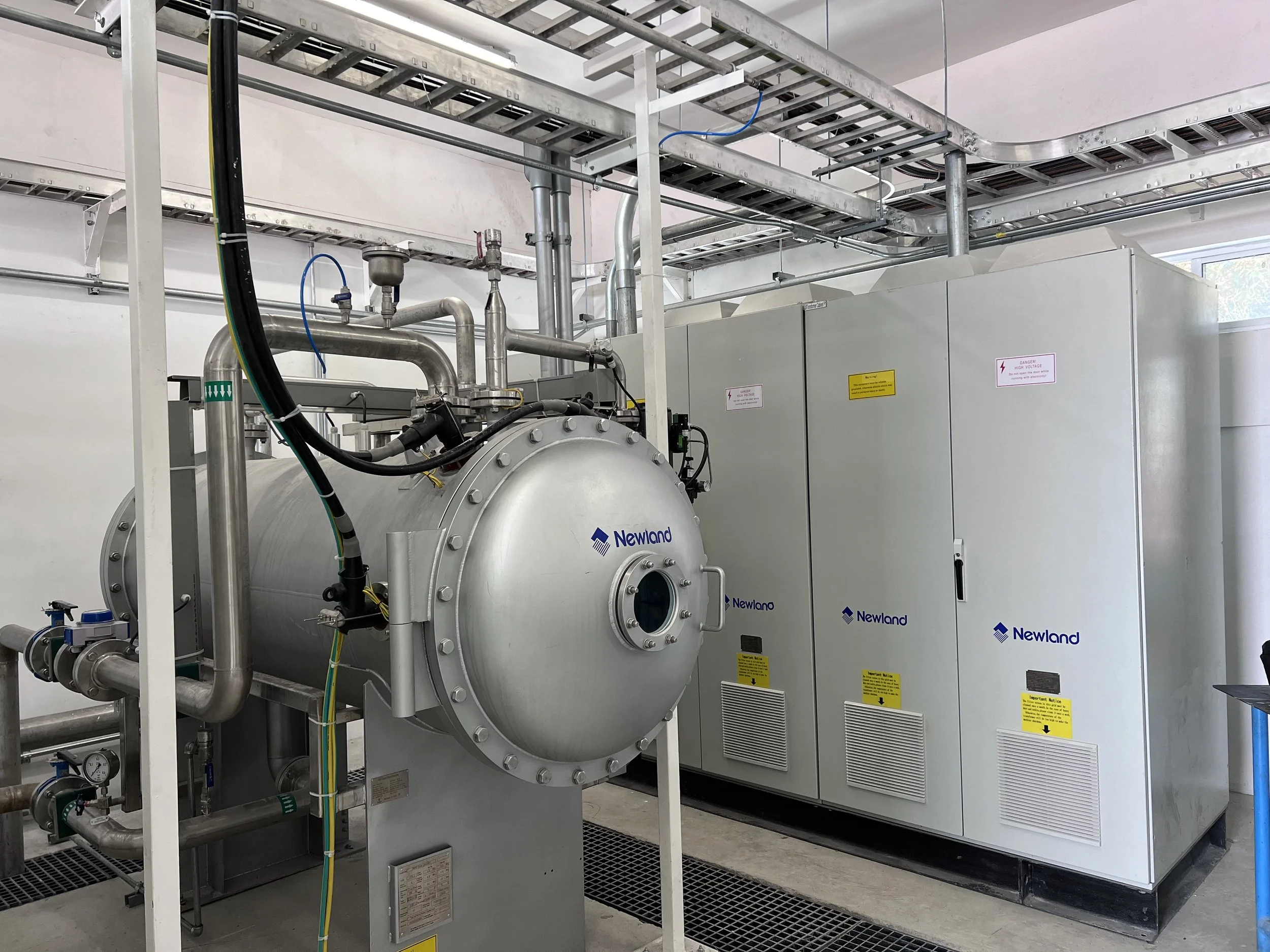
Corona-Discharge Ozone Generation
Longking NLO generators use corona-discharge technology to convert oxygen molecules contained in the conditioned feed gas into ozone.
The NLO platform uses a horizontal ozone-generation reactor together with high-frequency power electronics and dielectric discharge elements, creating the controlled electrical discharge required for ozone formation.
Double Micro-Gap Discharge Technology
The Longking generator architecture uses a double micro-gap dielectric-barrier discharge configuration designed to provide controlled electrical discharge across the ozone-generation elements.
The modular internal arrangement also allows individual discharge elements to be integrated within the overall reactor architecture.
Power Supply & Ozone Production Control
Each ozone generator is combined with its corresponding power-supply unit (PSU) and local control system.
Ozone production can be regulated by coordinating electrical power with the required feed-gas conditions, allowing the generator output to respond to the ozone demand defined by the plant control strategy.
Integrated Gas-Phase Ozone Measurement
Longking NLO systems can incorporate a high-concentration ozone analyser in the product-gas line to monitor the ozone concentration generated by the unit.
Combined with gas-flow measurement, this allows the control system to determine and supervise the actual ozone-production conditions of the generator.
PLC-Based Generator Control
Each NLO unit uses a PLC-based local control architecture for monitoring and adjustment of generator operating parameters.
Depending on the project configuration, the HMI can display parameters such as:
Generator operating status
Ozone production
Gas flow and pressure
Ozone concentration
Cooling conditions
Electrical status
Warnings and alarms
Communication with the plant control system can then coordinate the individual generators with the complete ozone installation.
Two Generators, One Integrated Ozone System
The two Madín II generators should not be viewed as independent pieces of equipment.
Their operation is coordinated with the dry-air preparation system, cooling circuit, ozone distribution, process instrumentation and plant automation, so that the complete installation responds to the actual ozone-treatment requirements.
Closed-Loop Cooling for the Ozone Generators
The Madín II ozone installation incorporates closed-loop water cooling for the NLO ozone generators.
Although the generators use treated dry air as feed gas, the ozone-generation process produces heat that must be removed continuously from the discharge section during operation.

Why Ozone Generators Need Cooling
Corona-discharge ozone generation converts only part of the electrical energy into ozone. The remaining energy is largely released as heat.
Controlling this thermal load is important because excessive temperature can affect the operating conditions of the ozone-generation process.
The cooling system therefore forms an essential part of the ozone generator package rather than an independent auxiliary service.
Closed Primary Cooling Circuit
In a closed-loop configuration, cooling water is continuously recirculated between the ozone generator and the heat-rejection equipment.
This provides a controlled hydraulic circuit for the generator and reduces direct dependence on variations in the plant's external cooling-water conditions.
The circuit can include monitoring of:
Cooling-water temperature
Water flow
Operating pressure
Cooling-equipment status
Heat Rejection
Heat collected from the ozone generators must ultimately be transferred outside the closed circuit.
Depending on the project design, this can be achieved through dedicated chilling equipment or a heat-exchange system connected to the plant's cooling utilities.
The required thermal capacity is defined according to the generator duty, operating conditions and available site utilities.
Cooling & Generator Protection
Cooling-system status can be integrated into the ozone-generator PLC.
If the required cooling conditions are not available, alarms and project-specific protective interlocks can prevent or limit ozone production in order to protect the equipment.
Integrated Thermal Management
At Madín II, cooling must be coordinated with the two NLO generators, dry-air system, electrical equipment and plant automation.
This is another example of why an ozone plant must be engineered as an integrated system: ozone production, feed gas and thermal management directly influence one another.
Ozone Gas Distribution & Contact System
After ozone is generated, the ozone-containing gas must be transported from the generators to the water-treatment process under the required flow, concentration and pressure conditions.
The gas distribution and application system therefore forms the link between the ozone-generation equipment and the hydraulic treatment process.
Ozone Gas Distribution
The product gas leaving the ozone generators is routed towards the point of application through an ozone-compatible gas distribution system.
The design must consider:
Total ozone gas flow
Ozone concentration
Operating pressure
Pressure losses through piping and components
Distance between the ozone plant and application point
Materials exposed to ozone
Plant layout and safety requirements
Gas production and downstream distribution must be engineered together so that the required operating conditions are maintained at the point where ozone is introduced into the water.
Ozone Transfer into Water
Once the ozone-containing gas reaches the treatment stage, ozone must be transferred from the gas phase into the liquid phase.
The effectiveness of this process depends on several interacting parameters, including:
Water flow
Required ozone dose
Gas flow and ozone concentration
Water depth
Contact time
Hydraulic behaviour
Water temperature
Ozone demand of the treated water
For this reason, the contact system should not be selected only from the nominal ozone production of the generators.
Contact Chamber Hydraulics
The hydraulic behaviour of the contact chamber can have a significant influence on the effectiveness of the ozonation stage.
Poor flow distribution can create short-circuiting, dead zones or ineffective use of the available contact volume.
When required by the project, Longking can support the design with CFD-based hydraulic studies to evaluate parameters such as flow distribution, baffle configuration, T10 and residence time.
Madín II: Integration with the Treatment Process
For Madín II, the confirmed ozone-generation system consists of two NLO A7.5K units providing 15 kg O₃/h total capacity with treated dry-air feed for a 47,800 m³/day drinking-water plant.
The ozone application stage must therefore be coordinated with the operating conditions of these generators and with the hydraulic requirements of the drinking-water treatment process.
The exact diffuser arrangement and contact-chamber configuration should only be described from the final project documentation.
Residual Ozone & Off-Gas Destruction
Not all of the ozone introduced into a contact system is necessarily transferred or consumed in the water.
Residual ozone can therefore remain in the gas leaving the contact chamber. This ozone-containing off-gas must be collected and treated before discharge, forming another important subsystem of the complete ozone plant.

Off-Gas Collection
The gas leaving the ozone contact stage is collected from the upper section of the contact system and routed towards the residual-ozone treatment equipment.
The off-gas system must be engineered according to parameters such as:
Gas flow
Residual ozone concentration
Moisture content
Pressure conditions
Contact-system configuration
Required discharge conditions
Moisture Management
Off-gas leaving a water-contact process can contain moisture or entrained droplets.
Where required, a demisting or moisture-separation stage can be installed upstream of the ozone destruction equipment to condition the gas before treatment.
This helps protect the downstream equipment and maintain suitable operating conditions within the destruction stage.
Thermo-Catalytic Ozone Destruction
Longking ozone destruction systems can use a thermo-catalytic process in which the off-gas is conditioned and passed through a catalytic reactor.
The catalyst promotes the decomposition of residual ozone back into oxygen:
2 O₃ → 3 O₂
The required reactor duty and operating conditions are defined according to the actual off-gas flow, ozone load, moisture conditions and project-specific discharge requirements.
Gas Extraction & Pressure Management
Depending on the installation, the off-gas system can incorporate extraction equipment and pressure monitoring to route the gas through the destruction stage under controlled conditions.
This can also help maintain the required pressure conditions within the ozone contact system and reduce the possibility of uncontrolled ozone release.
Integration with the Complete Ozone Plant
The ozone destruction stage is coordinated with the contact system, off-gas piping, ventilation, ozone detection and plant automation.
Its role is therefore not simply to act as an isolated piece of equipment, but to complete the residual-ozone management strategy of the overall installation.
Madín II Equipment Integration
The Madín II installation provides a useful example of how ozone generation and residual-ozone treatment form part of the same engineered system.
The presence of dedicated ozone-destruction equipment illustrates the importance of considering not only how ozone is generated and transferred into the water, but also how any remaining ozone is safely managed after the contact process.
Instrumentation, Automation & Process Control
A complete ozone plant requires coordinated control of the feed-gas preparation system, ozone generators, cooling equipment, ozone application stage and residual-ozone treatment system.
Longking uses a PLC-based control architecture to monitor the main operating parameters, coordinate equipment sequences and integrate the ozone plant with the overall water-treatment automation system.
Ozone Generator Monitoring
The NLO generators can monitor key operating parameters such as:
Generator operating status
Ozone production
Feed-gas flow and pressure
Ozone concentration in the product gas
Operating temperatures
Cooling-water conditions
Electrical status
Warnings and alarms
These signals allow the control system to supervise the operating conditions of each generator and coordinate its operation with the rest of the ozone plant.
Feed-Gas & Cooling Permissives
Ozone production should only take place when the required auxiliary conditions are available.
The control architecture can therefore incorporate operating permissives linked to parameters such as:
Feed-gas availability
Required gas pressure and flow
Cooling-water flow
Cooling-water temperature
Auxiliary-equipment status
If the required operating conditions are not met, project-specific alarms or protective interlocks can prevent ozone production or initiate an appropriate shutdown sequence.
Ozone Production Control
Ozone-generator output can be adjusted according to the treatment requirements and the control philosophy defined for the plant.
Depending on the project, ozone production may be coordinated with process variables such as water flow, required ozone dose and selected treatment measurements.
The exact dosing algorithm should be defined according to the water-treatment process rather than applying a single control strategy to every ozone installation.
Off-Gas Treatment Integration
Residual-ozone treatment can also be incorporated into the overall automation philosophy.
The control system can coordinate the off-gas extraction equipment, ozone destruction unit, relevant pressure signals and equipment status with the operating condition of the ozone application system.
This helps ensure that residual-ozone management is treated as part of the complete process rather than as an independent auxiliary function.
Plant PLC / SCADA Integration
The ozone plant can communicate with the main PLC/SCADA system for operating commands, status monitoring, alarms and exchange of relevant process data.
The final communication architecture and protocol are defined according to the project requirements and the existing plant automation system.
Madín II as an Integrated Plant
At Madín II, the ozone-generation equipment forms part of a full-scale drinking-water treatment installation in which the different subsystems must operate in a coordinated manner.
The project therefore illustrates an important principle of ozone engineering:
feed gas + ozone generation + cooling + application + off-gas treatment + automation must operate as one integrated process system.
Ozone Safety & Plant Protection
Ozone is a powerful oxidizing gas and must be handled within a properly engineered containment, ventilation, detection and control strategy.
In a complete ozone installation, safety functions are coordinated with the ozone generators, gas distribution, off-gas treatment and plant automation system.
Ambient Ozone Detection
Ozone detectors can be installed in relevant equipment areas to monitor the ambient atmosphere for possible ozone leakage.
Detector signals can be integrated into the control system to generate:
Local and remote alarms
Ventilation commands
Equipment-protection interlocks
Project-specific shutdown sequences
The number and location of detectors are defined according to the equipment layout, ozone capacity and ventilation design.
Ventilation
Ozone-generation rooms and enclosed equipment areas require an appropriate ventilation strategy.
Depending on the plant layout, the ventilation system can be coordinated with the ozone detection system and the overall automation architecture.
Ventilation requirements should be established according to the ozone inventory, room geometry, equipment arrangement and project safety criteria.
Gas Containment & Ozone-Compatible Materials
Components exposed to ozone must be selected using materials suitable for the expected ozone concentration, temperature, pressure and moisture conditions.
Gas piping, seals, valves and instrumentation should therefore be evaluated as part of the complete ozone system rather than treated as conventional air-service components.
Operating Interlocks
The control system can prevent ozone production when essential operating conditions are not available.
Typical project-specific interlocks may consider:
Feed-gas availability
Cooling-system status
Generator operating conditions
Ambient ozone alarms
Ventilation status
Off-gas treatment availability
The exact shutdown logic is defined during project engineering.
Off-Gas Pressure Management
Safe operation also requires control of the pressure conditions within the contact and off-gas systems.
Depending on the project, extraction equipment, pressure monitoring and protective valves can be used to maintain the required operating conditions and route residual ozone towards the destruction system.
Safety as Part of System Engineering
The key point is that ozone safety should not be designed after the main equipment has already been selected.
Generation, distribution, contact, off-gas treatment, ventilation, ozone detection and control logic should be engineered together from the beginning of the project.
Madín II provides a practical example of this complete-system approach, where ozone generation forms part of a wider municipal treatment installation requiring coordinated auxiliary and safety systems.
How the Complete Madín II Ozone Plant Works Together
The Madín II installation illustrates how a complete ozone plant operates as a sequence of interconnected process stages rather than as a collection of independent equipment.
For this project, the ozone system is based on two NLO A7.5K ozone generators, providing 15 kg O₃/h of total installed capacity with treated dry-air feed for a drinking-water treatment plant with a capacity of 47,800 m³/day.
1. Feed-Gas Preparation
Atmospheric air is conditioned before entering the ozone-generation stage.
The air-treatment system provides the generators with the required dryness, cleanliness, pressure and gas flow for corona-discharge ozone production.
2. Ozone Generation
The conditioned dry air is supplied to the two Longking NLO ozone generators.
Inside the generators, electrical energy is applied through the dielectric discharge system to convert part of the oxygen contained in the feed gas into ozone.
Generator output is regulated according to the operating requirements of the ozone plant.
3. Thermal Management
During ozone generation, heat is produced in the discharge section.
The closed-loop water-cooling system removes this thermal load and provides the operating conditions required by the generators.
Cooling status can be integrated into the generator control and protection logic.
4. Ozone Gas Distribution
The ozone-containing gas leaving the generators is transported towards the treatment process through an ozone-compatible gas distribution system.
Gas flow, concentration, pressure losses and piping configuration must be coordinated with the operating conditions of the generators and the downstream ozone application system.
5. Ozone Application & Contact
At the application stage, ozone must be transferred from the gas phase into the treated water.
The performance of this stage depends on the combined design of ozone dose, gas flow, water flow, transfer conditions, hydraulic contact time and water characteristics.
The ozone-generation system and the water-contact system must therefore be engineered as parts of the same treatment process.
6. Residual Ozone Management
Ozone remaining in the gas after the contact stage can be collected as off-gas.
Where required, the gas is routed through the residual-ozone treatment system, which can include moisture separation, gas extraction and thermo-catalytic ozone destruction before discharge.
7. Automation & Safety
The different subsystems are coordinated through the PLC-based control architecture of the ozone plant.
Feed-gas conditions, ozone generation, cooling, process interfaces, off-gas treatment, alarms and safety signals can be integrated into a common operating philosophy and connected to the plant PLC/SCADA system.
One Integrated Ozone Treatment System
The complete process can therefore be summarized as:
Air preparation → Ozone generation → Cooling → Gas distribution → Ozone transfer & contact → Off-gas treatment → Automation & safety
The key engineering principle is that each stage affects the operating conditions of the next.
Madín II therefore demonstrates why a municipal ozone plant should be designed as one integrated process system, with equipment, utilities, hydraulics, instrumentation and safety considered together from the beginning of the project.
Why Madín II Is a Useful Ozone Equipment Reference
Madín II is particularly useful as a technical reference because it shows how the different subsystems of a full-scale ozone plant must work together around the ozone generators.
The project combines treated dry-air preparation, two NLO ozone generators, closed-loop cooling, ozone gas distribution and application, residual-ozone treatment, instrumentation, automation and safety systems within a municipal drinking-water installation.
More Than an Ozone Generator
The 15 kg O₃/h installed capacity is only one part of the overall system.
Reliable ozone treatment also depends on providing the generators with the correct feed-gas and cooling conditions, transporting the ozone safely to the application point, managing residual ozone and coordinating all equipment through the plant-control architecture.
Real Equipment, Real Plant Integration
The photographs from Madín II provide a practical view of the equipment used within an actual municipal ozone installation, including the NLO ozone-generation equipment, cooling system and residual-ozone destruction equipment.
This makes the project a useful example of how Longking approaches ozone systems from an equipment and integration perspective, rather than treating the ozone generator as an isolated machine.
Engineering the Complete Ozone Process
The key lesson from Madín II is that successful ozone projects require coordination between:
process requirements + ozone generation + utilities + hydraulics + auxiliary equipment + automation + safety
Longking develops these elements as part of the complete ozone-treatment system, adapting the final configuration to the required ozone duty, water characteristics, operating conditions and available plant infrastructure.
Read the Full Madín II Project Reference
For the complete project overview, including plant capacity, customer/end user and the main ozone-system configuration, see:
Madín II Drinking Water Plant: 15 kg/h Dry-Air Ozone System in Mexico
Need Support Engineering a Complete Ozone Plant?
An ozone plant involves much more than selecting the required ozone-production capacity.
Longking EnTech Europe can support the integration of feed-gas preparation, ozone generation, cooling, ozone application, off-gas treatment, instrumentation, automation and safety systems as part of a complete municipal or industrial ozone-treatment solution.
Contact our team to discuss your ozone-system requirements.