

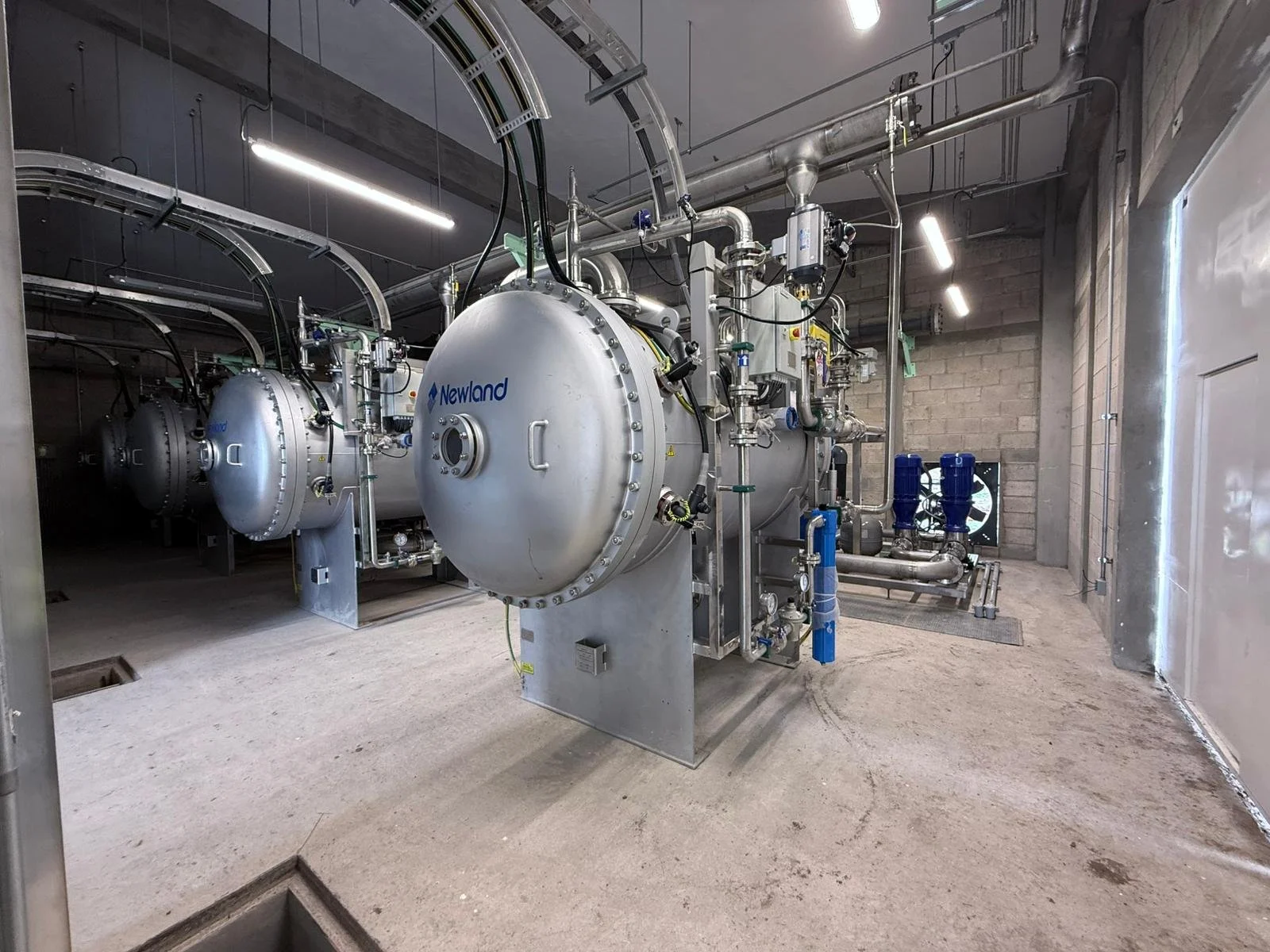
Large-Capacity LOX-Fed Ozonation for Municipal Wastewater Treatment
Longking supplied a 160 kg O₃/h ozone generation system for the El Ahogado Wastewater Treatment Plant in Jalisco, Mexico, as part of the plant’s high-flow wastewater treatment and disinfection process.
The system is based on NLO-2G ozone generators using liquid oxygen (LOX) as the feed-gas source and is engineered for continuous operation at large municipal treatment capacity.
El Ahogado WWTP treats approximately 3,250 L/s, with the project also associated with an additional 1,000 L/s treatment-capacity expansion, making the installation a significant reference for large-scale ozonation in municipal wastewater treatment.
Beyond the ozone generators themselves, installations of this scale require coordinated engineering of the oxygen supply, ozone generation, cooling, gas distribution, ozone contact process, off-gas treatment, instrumentation, automation and safety systems.
This project demonstrates the application of Longking’s large-capacity ozone technology in a municipal wastewater plant where high ozone production, process integration and reliable continuous operation are critical design requirements.
Project Scope & Key Data
The El Ahogado WWTP project combines large municipal wastewater flows with high-capacity ozone generation, requiring the ozone system to operate as part of an integrated treatment process rather than as standalone equipment.
Key Project Data
Project: El Ahogado Wastewater Treatment Plant
Location: Jalisco, Mexico
Application: Municipal wastewater treatment and disinfection
Plant treatment capacity: approximately 3,250 L/s
Associated capacity expansion: approximately 1,000 L/s
Total installed ozone capacity: 160 kg O₃/h
Ozone generator platform: Longking NLO-2G
Feed gas: Liquid oxygen (LOX)
Operating concept: Large-capacity continuous ozone production
Longking Supply & Engineering Scope
The ozone generation package is centered on Longking’s NLO-2G industrial ozone technology, configured to provide the required total ozone production capacity for the plant.
At this scale, the engineering scope must consider the complete ozone process, including:
LOX feed-gas supply and conditioning
Ozone generation
Generator cooling
Ozone gas distribution
Integration with the wastewater contact process
Residual ozone and off-gas management
Instrumentation and automation
Ozone detection and safety interlocks
The exact configuration of auxiliary equipment and process interfaces is defined according to the final plant design and operating requirements.
Why the Scale Matters
An installed ozone capacity of 160 kg O₃/h places El Ahogado among Longking’s significant large-capacity water-treatment references.
Systems of this size require more than simply increasing generator output. The design must coordinate gas production, cooling capacity, hydraulic process conditions, ozone transfer, control architecture and operational redundancy so that the overall installation can operate reliably under the required plant conditions.
Why Ozone at El Ahogado WWTP?
At a municipal wastewater treatment plant of this scale, ozone can be integrated as an advanced treatment and disinfection step where high treatment capacity must be combined with reliable process control.
Ozone is a powerful oxidant that can contribute to wastewater treatment through several mechanisms, depending on the specific process objectives and water characteristics.
Disinfection
Ozone can inactivate a wide range of microorganisms when the required ozone dose, dissolved residual and effective contact time are achieved.
For large wastewater flows, the disinfection performance depends not only on ozone production capacity, but also on the design of the gas-liquid contact system and hydraulic residence time.
Oxidation of Residual Compounds
Ozone can also oxidize selected residual organic and inorganic compounds that remain after upstream biological treatment.
The actual oxidation performance depends on the wastewater matrix, ozone demand and specific treatment targets.
Process Integration Is Critical
In a plant such as El Ahogado, the ozone system must operate as part of the complete treatment process.
The engineering therefore has to coordinate:
Ozone production
Gas transfer efficiency
Contact-chamber hydraulics
Water flow variation
Residual ozone management
Off-gas treatment
Automation and safety
The effectiveness of the process depends on the performance of the complete ozonation system, not only on the nominal kg O₃/h capacity of the generators.
Large-Flow Wastewater Applications
High-flow municipal applications create specific engineering challenges because the system must maintain stable ozone production and process performance across changing operating conditions.
This requires an integrated approach combining ozone generation, process control, hydraulic design and plant integration.
NLO-2G Ozone Generator Technology
The El Ahogado installation is based on Longking’s NLO-2G industrial ozone generator platform, developed for large-capacity applications requiring stable ozone production and continuous operation.
For projects at this scale, the ozone generator must be considered as part of a complete process system in which feed-gas quality, cooling, electrical supply, control and downstream ozone utilisation directly influence overall performance.
High-Capacity Ozone Generation
The NLO-2G platform is designed for industrial applications where large ozone production capacities are required.
At El Ahogado, the installed system provides a total ozone production capacity of 160 kg O₃/h, allowing the plant to integrate ozonation into a high-flow municipal wastewater treatment process.
Oxygen-Fed Operation
The El Ahogado system uses liquid oxygen (LOX) as the feed-gas source.
Using high-purity oxygen allows the ozone generation system to operate at higher ozone concentrations than conventional dry-air-fed configurations and reduces the total gas volume that must be handled for a given ozone production capacity.
For large installations, this has direct implications for:
Generator sizing
Gas distribution
Ozone transfer equipment
Cooling requirements
Off-gas management
Overall plant integration
Thermal Management
Ozone generation produces significant heat, making effective cooling essential for stable and efficient operation.
Large-capacity ozone systems therefore require a properly engineered cooling circuit capable of maintaining the generator within its defined operating temperature range under continuous load.
The cooling system must be coordinated with the generator capacity, ambient conditions and plant utility design.
Automation & Process Control
Industrial ozone installations require continuous monitoring and coordinated control of the ozone generation process.
Typical control parameters include:
Ozone production
Feed-gas conditions
Cooling-water conditions
Generator electrical parameters
Process alarms
Safety interlocks
Remote operating signals
This allows the ozone production system to respond to the operating requirements of the treatment plant while maintaining defined equipment protection and safety conditions.
Designed as Part of the Complete Ozone System
The NLO-2G generator is only one element of the overall ozonation process.
Reliable operation depends on the integration of:
oxygen supply → ozone generation → cooling → gas distribution → ozone transfer → contact process → off-gas treatment → process control and safety
For projects such as El Ahogado, this system-level engineering is particularly important because the scale of the installation magnifies the effect of any limitation in the auxiliary or downstream processes.
Ozone Contact, Off-Gas Treatment & Safety
Producing 160 kg O₃/h is only the first step in the ozonation process.
For a large municipal wastewater application, the ozone must then be transferred efficiently into the water, given sufficient contact under controlled hydraulic conditions, and safely managed throughout the gas and liquid process.
Ozone Transfer & Contact
The ozone generated by the NLO-2G system must be transferred from the gas phase into the wastewater before it can perform its oxidation and disinfection functions.
The design of the transfer and contact system depends on parameters such as:
Water flow
Applied ozone dose
Gas flow and ozone concentration
Water depth
Ozone demand
Contact-chamber geometry
Hydraulic residence time
Required dissolved ozone conditions
For high-flow plants, the objective is not simply to inject ozone, but to achieve stable gas-liquid contact across the required operating range.
Contact-Chamber Hydraulics
Hydraulic behaviour directly affects the utilisation of transferred ozone.
Short-circuiting, dead zones or uneven flow distribution can reduce the effective contact time available for the process.
Depending on the project requirements, engineering tools such as hydraulic analysis and CFD modelling can be used to evaluate:
Flow distribution
Residence-time behaviour
Potential short-circuiting
Dead zones
Baffle configuration
Gas-distribution strategy
This allows the contact system to be designed as an integral part of the ozonation process rather than as a simple storage volume.
Residual Ozone & Off-Gas Management
Not all ozone introduced into the contact process is necessarily consumed in the water.
Residual ozone in the gas phase must therefore be safely collected and managed before discharge.
Depending on the final system design, this can involve:
Off-gas collection
Moisture separation
Controlled extraction
Residual ozone destruction
Pressure monitoring
Safe discharge of treated gas
The exact configuration depends on the contact-system design and project requirements.
Ozone Safety
Ozone is a strong oxidizing gas and requires dedicated safety measures throughout the installation.
A large-capacity system should consider coordinated protection through:
Ambient ozone detection
Ventilation
Gas-pressure monitoring
Process interlocks
Automatic shutdown logic
Alarm management
Controlled access to ozone areas
The safety architecture should be integrated into the overall control philosophy of the treatment plant.
System-Level Engineering
At the scale of El Ahogado, reliable ozonation depends on the coordination of the complete process:
LOX supply → ozone generation → cooling → gas distribution → ozone transfer → hydraulic contact → residual ozone management → automation and safety
The performance of the installation therefore depends on the complete engineered system rather than on ozone-generator capacity alone.
Automation, Monitoring & Operational Reliability
Large-capacity ozone systems require continuous monitoring and coordinated control to maintain stable operation, protect the equipment and respond safely to changing plant conditions.
At El Ahogado, the ozone installation must operate as part of a high-flow municipal wastewater treatment process, where reliability depends on the coordination of the ozone generators, feed-gas system, cooling, process interfaces and safety functions.
Continuous Process Monitoring
A large ozone system typically requires monitoring of key operating parameters such as:
Ozone production
Feed-gas pressure and flow
Cooling-water conditions
Electrical operating parameters
Process status
Alarm conditions
Safety signals
Remote operating commands
The purpose is not only to monitor the generator itself, but to ensure that the complete ozone system remains within its defined operating conditions.
Interlocks & Equipment Protection
Automatic interlocks are essential to protect the ozone generators and auxiliary equipment when abnormal conditions are detected.
Depending on the final system architecture, protective logic can respond to conditions such as:
Loss of feed gas
Insufficient cooling
Abnormal pressure
Electrical faults
High ambient ozone concentration
Auxiliary-equipment failure
External plant shutdown signals
The control philosophy should prioritize safe shutdown and controlled restart rather than allowing the equipment to continue operating outside its required conditions.
Integration with the Treatment Plant
The ozone system should not operate as an isolated package.
Its control architecture can be integrated with the plant’s central automation system so that operating status, alarms and relevant process signals can be exchanged with the wider WWTP control environment.
This allows ozone production to be coordinated with the actual requirements of the treatment process.
Operational Flexibility
Municipal wastewater treatment plants rarely operate at one constant hydraulic condition.
Flow, water quality and process demand can vary over time, so the ozone system should be capable of adapting its production within the defined operating range.
This flexibility helps avoid operating the system unnecessarily at maximum capacity when the process requires less ozone.
Reliability at Large Scale
At 160 kg O₃/h, operational reliability becomes a system-level requirement.
Stable performance depends on the coordinated availability of:
LOX supply + ozone generation + cooling + gas distribution + contact process + off-gas management + automation + safety
For large-capacity installations, the design philosophy should therefore consider not only nominal production, but also operability, maintainability, fault response and continuity of service.

Why El Ahogado Is a Significant Longking Reference
The El Ahogado WWTP project is a relevant Longking reference because it combines large wastewater treatment capacity with a 160 kg O₃/h ozone generation system in a demanding municipal application.
Projects of this scale require more than the selection of individual ozone generators. They require coordinated engineering across the complete process, from the oxygen supply to the final integration with the treatment plant.
Large Installed Ozone Capacity
With 160 kg O₃/h of installed ozone production, El Ahogado demonstrates Longking’s capability to supply ozone technology for high-capacity municipal wastewater applications.
The scale of the system places particular importance on:
Feed-gas management
Cooling
Electrical and control architecture
Gas distribution
Ozone transfer
Contact hydraulics
Off-gas management
Safety
Integration into a High-Flow Municipal Plant
El Ahogado WWTP operates at approximately 3,250 L/s, with an associated treatment-capacity expansion of approximately 1,000 L/s.
This requires the ozone system to be engineered around the real hydraulic and operational conditions of a large municipal wastewater treatment plant rather than as an isolated equipment package.
System Engineering Experience
The project illustrates the importance of treating ozone as a complete process.
Longking’s role in projects of this type is based on integrating:
ozone generation + utilities + process interfaces + contact-system requirements + automation + safety
so that the ozone equipment can operate as part of the wider treatment process.
Relevant Experience for Future Projects
El Ahogado provides a useful reference for projects involving:
Large municipal wastewater treatment plants
High-capacity ozone generation
LOX-fed ozone systems
Advanced wastewater treatment
Disinfection
Large-scale ozone process integration
The engineering principles demonstrated at El Ahogado are applicable to other high-flow projects where ozone must be integrated reliably into a complete treatment process.
Need Support with a Large-Capacity Ozone Project?
Longking EnTech Europe supports municipal and industrial water-treatment projects requiring large-capacity ozone generation and complete process integration.
Our engineering scope can include the definition and integration of:
Feed-gas supply
Ozone generation
Cooling systems
Ozone transfer and contact
Off-gas treatment
Instrumentation and automation
Safety systems
Integration with the overall treatment process
For large-scale projects, the system should be designed around the actual flow, water quality, ozone demand, process objectives and plant constraints.
Contact our team with your project requirements and design data.