

What are the differences between NLQ-H, NLQ-V and NLQ-HPV UV systems?
Longking EnTech Europe offers three main configurations within its NLQ open-channel UV disinfection portfolio: NLQ-H, NLQ-V and NLQ-HPV.
These systems use low-pressure amalgam UV lamp technology and are designed for municipal wastewater treatment, tertiary disinfection, water reuse and selected industrial applications.
The principal differences lie in lamp orientation, electrical power and module configuration:
NLQ-H — Horizontal UV modules: 320 W low-pressure amalgam lamps arranged horizontally within open channels.
NLQ-V — Vertical UV modules: 320 W low-pressure amalgam lamps in a vertical configuration.
NLQ-HPV — High-power vertical UV modules: 800 W low-pressure amalgam lamps, with 16 lamps per reference module.
These alternatives allow engineers to evaluate different solutions according to treatment capacity, hydraulic conditions, available channel dimensions and maintenance requirements.
Why does UV module configuration matter?
The effectiveness of an open-channel UV disinfection system depends on more than the installed lamp power.
Water flow, UV transmittance (UVT), suspended solids, hydraulic exposure conditions, lamp characteristics and required microbial reduction must all be considered during equipment selection.
A horizontal arrangement may be more appropriate for certain channel geometries, while a vertical configuration may offer advantages in other installations. High-power UV modules can provide additional design alternatives for large treatment capacities, but higher electrical power does not automatically mean greater system efficiency.
Longking EnTech Europe's approach is to select the most suitable UV configuration for each project, combining disinfection engineering, hydraulic integration, automatic cleaning, power regulation and PLC-based control.
The following sections explain how open-channel UV systems operate, the differences between the three NLQ configurations and the technical factors that determine their suitability for new installations and retrofit projects.

How does open-channel UV disinfection work in wastewater treatment?
Open-channel ultraviolet (UV) disinfection is widely used in municipal wastewater treatment plants, tertiary treatment facilities and water reuse applications to inactivate microorganisms without adding chemical disinfectants to the water.
The process uses UV-C radiation to damage the genetic material of microorganisms, reducing their ability to reproduce or cause infection.
In an open-channel installation, wastewater flows through UV modules containing lamps protected by quartz sleeves. The effectiveness of disinfection depends on the radiation received by microorganisms as they pass through the irradiation zone.
What are the main advantages of open-channel UV disinfection?
When appropriately designed and operated, UV disinfection offers several benefits:
Disinfection without chemical dosing: UV irradiation does not require adding chlorine or other chemical disinfectants for its disinfection mechanism.
No persistent chemical residual: UV does not leave a disinfectant residual in the treated water, which can be advantageous for certain discharge applications.
Microbial inactivation: UV can effectively inactivate bacteria, viruses and protozoa, depending on the microorganisms involved and the delivered UV dose.
Integration into existing treatment plants: Open-channel UV modules can be incorporated into new facilities or evaluated for modernization of existing channels.
Automatic operation: UV intensity monitoring, lamp power regulation, cleaning systems and PLC-based control support operational supervision.
Reduced chemical handling: Where UV replaces chemical disinfection, the need for disinfectant storage and handling may be reduced.
Unlike conventional chlorination, UV disinfection does not rely on the addition of chlorine and therefore avoids the formation of chlorination by-products associated specifically with that dosing process.
However, UV irradiation should not be described as completely incapable of producing chemical transformation products. Photochemical reactions depend on the water composition and treatment conditions.
What determines the effectiveness of UV disinfection?
The performance of an open-channel UV system depends on several interacting factors:
UV transmittance (UVT): The ability of UV-C radiation to penetrate the treated water, generally evaluated at 254 nm through a 1 cm optical path.
Water flow: Flow rate and hydraulic conditions determine the exposure experienced by water passing through the UV modules.
Suspended solids: Particles can shield microorganisms and reduce effective disinfection.
Lamp output: Germicidal UV-C emission depends on lamp technology, operating power and ageing.
Quartz sleeve condition: Fouling reduces UV transmission and must be managed through suitable cleaning and maintenance.
Microbiological requirements: Different microorganisms require different UV exposures to achieve the desired inactivation.
Hydraulic design: Flow distribution, water levels and module arrangement influence the UV exposure achieved.
These parameters must be considered together during the system design and validation process.
How do Longking NLQ systems maintain operational control?
Longking's NLQ open-channel UV systems incorporate low-pressure amalgam lamp technology, automatic mechanical cleaning, UV intensity monitoring and PLC-based automation.
Depending on the configuration, the control system can adjust lamp power according to available operating signals, such as water flow and UV transmittance.
This can help optimize energy consumption while maintaining the required disinfection operating conditions.
However, UV intensity is not equivalent to delivered UV dose, and automatic power regulation does not guarantee the required disinfection performance outside the system's design or validated operating range.
Low-pressure amalgam lamps also require appropriate warm-up and stabilization conditions. They should not be presented as providing instantaneous full-output operation following every start.
For reliable operation, the UV system must be correctly sized, appropriately controlled and maintained throughout its service life.
The NLQ-H, NLQ-V and NLQ-HPV configurations provide different engineering alternatives for meeting these requirements in open-channel installations.
Horizontal vs vertical open-channel UV systems: which configuration is better?
Open-channel UV disinfection systems can use horizontal or vertical lamp arrangements, depending on the hydraulic conditions, channel geometry, required treatment capacity and maintenance requirements.
Longking EnTech Europe offers three main configurations: NLQ-H (horizontal, 320 W), NLQ-V (vertical, 320 W) and NLQ-HPV (high-power vertical, 800 W).
There is no universally superior orientation. The most appropriate configuration depends on how effectively the UV modules can deliver the required disinfection performance within the available hydraulic infrastructure.
NLQ-H: horizontal open-channel UV modules with 320 W lamps
The Longking NLQ-H Series incorporates 320 W low-pressure amalgam UV lamps arranged horizontally in open-channel modules.
This configuration can be considered for wastewater treatment installations where the channel geometry, operating water levels and maintenance conditions are compatible with horizontal UV equipment.
Main characteristics include:
Horizontal arrangement of 320 W amalgam UV lamps.
Modular configuration for open-channel disinfection.
Automatic mechanical quartz sleeve cleaning with pneumatic actuation.
Optional online chemical-assisted cleaning for compatible module configurations.
UV intensity monitoring and water-level protection.
PLC-based control and automatic lamp power regulation.
Stainless steel construction adapted to submerged and non-submerged conditions.
NLQ-H can be particularly relevant for new installations and retrofit projects where the existing channel dimensions favour horizontal modules.
However, the suitability of the arrangement must be verified through project-specific hydraulic assessment and UV sizing.
NLQ-V: vertical open-channel UV modules with 320 W lamps
The Longking NLQ-V Series uses 320 W low-pressure amalgam lamps arranged vertically within open-channel modules.
It provides an alternative to NLQ-H when the channel configuration, water depth, available installation space or maintenance arrangement favours a vertical system.
Main characteristics include:
Vertical arrangement of 320 W amalgam UV lamps.
Modular configuration adapted to the required treatment capacity.
Automatic pneumatic quartz sleeve cleaning.
UV intensity monitoring and water-level protection.
PLC/HMI control and lamp power regulation.
Integration with plant automation and SCADA systems where required.
Stainless steel construction suitable for wastewater treatment environments.
NLQ-V may offer practical advantages in installations where vertical module positioning provides a more suitable arrangement for the existing civil infrastructure.
However, vertical orientation alone does not guarantee improved hydraulic distribution, lower head loss or higher disinfection performance.
These aspects must be established through the design of the complete installation.
NLQ-HPV: high-power vertical UV modules with 800 W lamps
The Longking NLQ-HPV Series combines vertical module architecture with 800 W low-pressure amalgam UV lamps, providing a high-power alternative for open-channel disinfection.
The reference module incorporates 16 lamps, representing 12.8 kW of installed electrical lamp power per module.
Its principal characteristics include:
Vertical high-power UV module arrangement.
800 W low-pressure amalgam lamps.
Reference configuration of 16 lamps per module.
Automatic mechanical quartz sleeve cleaning with pneumatic actuation.
UV intensity monitoring and water-level protection.
PLC/HMI control with automatic power regulation.
Communication interfaces for plant automation integration.
Modular design for project-specific treatment configurations.
NLQ-HPV is particularly relevant for large municipal wastewater treatment plants, tertiary disinfection and water reuse installations requiring high UV treatment capacity.
Its high-power lamp configuration may allow engineers to evaluate solutions with fewer individual lamps or a different module arrangement than lower-power alternatives.
However, fewer lamps do not automatically mean lower energy consumption, reduced footprint or better disinfection performance.
These advantages must be demonstrated through equivalent UV sizing conditions and a comparison of the complete installations.
How should NLQ-H, NLQ-V and NLQ-HPV be compared?
The three configurations can be summarized as follows:
NLQ-H: Horizontal modules with 320 W lamps. An option when channel geometry and hydraulic conditions favour horizontal UV equipment.
NLQ-V: Vertical modules with 320 W lamps. An alternative when vertical positioning offers better compatibility with the installation.
NLQ-HPV: Vertical modules with 800 W lamps. A high-power alternative particularly relevant for large treatment capacities and demanding installation requirements.
The final choice should consider:
Design flow and operating variations.
UV transmittance (UVT) at 254 nm.
Total suspended solids (TSS).
Required disinfection performance.
Channel width, depth and available installation length.
Hydraulic head loss and water-level control.
UV lamp output and required number of modules.
Cleaning requirements and available utilities.
Maintenance accessibility.
Energy consumption and lifecycle cost.
Does vertical UV technology provide better disinfection than horizontal UV technology?
Not necessarily.
UV disinfection performance depends on the radiation field, water quality, hydraulic exposure conditions and the applicable design or validation methodology.
Neither vertical nor horizontal lamp orientation guarantees superior performance by itself.
The correct engineering objective is to identify the configuration that meets the required disinfection performance while providing suitable hydraulic integration, maintainability and operating efficiency.
Longking EnTech Europe's NLQ portfolio allows these alternatives to be evaluated within the same technology offering, helping utilities and engineering partners select the most suitable open-channel UV solution for each project.

What lamp technologies and module configurations are used in Longking NLQ systems?
The Longking NLQ open-channel UV disinfection portfolio uses low-pressure, high-output amalgam UV lamp technology to provide germicidal UV-C radiation for municipal wastewater treatment, tertiary disinfection and water reuse applications.
The three main configurations, NLQ-H, NLQ-V and NLQ-HPV, share the same general disinfection principle but differ in lamp power, module orientation and equipment arrangement.
These differences allow engineers to evaluate suitable configurations according to the required treatment capacity, hydraulic conditions and installation constraints.
320 W and 800 W low-pressure amalgam UV lamps
Longking's open-channel UV portfolio incorporates two main lamp power categories:
320 W amalgam lamps: Used in NLQ-H horizontal modules and NLQ-V vertical modules.
800 W amalgam lamps: Used in NLQ-HPV high-power vertical modules.
Both technologies produce germicidal UV-C radiation, primarily around 254 nm, and are designed for wastewater disinfection applications.
The electrical lamp power is not equivalent to the germicidal UV-C output.
For reference, the nominal technical characteristics of the corresponding Longking lamp technologies include:
320 W lamp: Approximately 105 W of germicidal UV-C output.
800 W lamp: Approximately 256 W of germicidal UV-C output.
These values refer to specified lamp characteristics under defined operating conditions. Actual UV-C output changes with operating power, temperature, lamp ageing and other relevant conditions.
Therefore, the comparison between lamp technologies must consider the corresponding technical documentation and the assumptions used during UV system sizing.
Modular configuration and installed UV capacity
The NLQ Series uses modular structures that support the installation of multiple UV lamps within an open-channel disinfection system.
The module configuration depends on the selected technology and project requirements.
NLQ-H — Horizontal configuration
NLQ-H modules incorporate 320 W low-pressure amalgam lamps arranged horizontally. The number of lamps and modules is selected according to the treatment requirements and available channel geometry.
NLQ-V — Vertical configuration
NLQ-V modules use 320 W low-pressure amalgam lamps in a vertical arrangement, providing an alternative configuration for projects where vertical integration is preferable.
NLQ-HPV — High-power vertical configuration
The reference NLQ-HPV module incorporates 16 lamps rated at 800 W each, corresponding to 12.8 kW of installed electrical lamp power per module.
This high-power arrangement provides an alternative for large wastewater treatment plants where substantial UV treatment capacity is required.
However, the installed electrical power must not be interpreted as the UV dose delivered to the water.
What determines the UV dose delivered by each configuration?
UV dose, commonly expressed in mJ/cm², depends on the radiation received by microorganisms during their passage through the UV treatment system.
It is influenced by:
Germicidal UV-C output and lamp ageing.
UV transmittance of the treated water.
Suspended solids and potential microorganism shielding.
Quartz sleeve transmission and fouling.
Hydraulic velocity and exposure conditions.
Number, position and arrangement of UV lamps.
Operating power and applicable control strategy.
A higher-power lamp does not automatically provide a higher effective dose or better energy performance at system level.
The comparison between NLQ-H, NLQ-V and NLQ-HPV must therefore be based on equivalent treatment conditions and the applicable design or validation methodology.
Stainless steel construction and quartz protection
Longking NLQ modules are designed for continuous operation in water treatment environments.
Their construction typically incorporates:
AISI 316L stainless steel for components submerged in treated water.
AISI 304 stainless steel for structural components located above water level, subject to project requirements.
High-transmission quartz sleeves protecting the UV lamps.
Modular support structures adapted to the equipment configuration.
Electrical and mechanical connections designed for the specified installation environment.
Materials and construction details must be confirmed according to the water characteristics, corrosion requirements and project specifications.
Automatic cleaning and maintenance
The NLQ-H, NLQ-V and NLQ-HPV configurations incorporate automatic mechanical quartz sleeve cleaning to limit fouling during operation.
Their standard pneumatic cleaning arrangements require a suitable compressed-air supply.
For selected compatible NLQ-H configurations, online chemical-assisted cleaning may also be evaluated as an optional solution.
Routine maintenance includes verification of lamp condition, quartz cleanliness, cleaning mechanisms, electrical components and relevant instrumentation.
How long do Longking UV lamps last?
UV lamp service life must be distinguished from guaranteed disinfection performance.
A lamp may remain operational beyond the period for which its germicidal output or disinfection performance is guaranteed under specified conditions.
The applicable nominal operating life, lamp ageing assumptions, UV-C output guarantees and replacement recommendations depend on the selected lamp technology and technical documentation.
For this reason, lamp durability should not be presented as an unconditional guarantee of UV dose or microbiological disinfection performance.
When comparing the different NLQ configurations, the evaluation should consider lamp replacement intervals, maintenance requirements, electricity consumption and the number of components installed.
The objective is to identify the configuration that provides the required disinfection performance with appropriate operational reliability and competitive lifecycle costs.
How do Longking NLQ UV systems control and monitor disinfection performance?
Reliable UV disinfection requires more than selecting the appropriate lamps and modules. Effective operation also depends on continuous monitoring, appropriate control strategies and integration with the wastewater treatment plant's automation system.
The Longking NLQ-H, NLQ-V and NLQ-HPV Series incorporate PLC-based automation, UV intensity monitoring, lamp power regulation and automatic quartz sleeve cleaning to support reliable operation under the specified treatment conditions.
The exact instrumentation, control functions and communication interfaces are defined according to the selected equipment configuration and project requirements.
UV intensity monitoring and water-level protection
UV intensity sensors provide information about the UV radiation detected at specific locations within the treatment system.
These measurements help operators identify changes potentially associated with lamp ageing, quartz sleeve fouling, operating conditions or equipment faults.
Depending on the selected configuration, operational monitoring can include:
UV intensity measurements and associated alarms.
Individual lamp operating status and fault detection.
Accumulated lamp operating hours.
Lamp power settings and operating conditions.
Channel water-level measurement and protective interlocks.
Automatic quartz sleeve cleaning status.
Relevant equipment alarms and operating events.
Flow and UV transmittance signals, when suitable instrumentation is available.
Water-level monitoring is particularly important in open-channel UV systems, where the lamps and quartz sleeves must operate within the specified immersion conditions.
The control system can incorporate alarms and protective actions when water levels fall outside the permitted operating range.
How does automatic lamp power regulation work?
Longking NLQ systems can regulate UV lamp power to adapt the operating conditions to the treatment requirements.
Depending on the equipment configuration and available instrumentation, power regulation may take into account:
Wastewater flow rate.
UV transmittance (UVT).
Measured UV intensity.
Required disinfection performance.
Configured operating and safety limits.
When treatment conditions are favourable, the control strategy may allow the lamps to operate at reduced power, potentially lowering electrical consumption.
When flow increases or water quality deteriorates, the system can increase lamp power within its available operating range.
However, automatic power regulation cannot compensate for conditions exceeding the installed UV treatment capacity.
The required disinfection performance must be assessed for the specified design conditions, including relevant operating margins.
Is UV intensity monitoring the same as UV dose measurement?
No. These are related but different parameters.
UV intensity represents the radiation measured by a sensor at a particular location.
UV dose, expressed in mJ/cm², represents the UV exposure delivered to microorganisms as they travel through the system.
Delivered dose depends on UV intensity distribution, hydraulic residence time, water quality and the characteristics of the UV installation.
A control system may calculate or estimate an operational UV dose using a defined methodology and appropriate input signals.
However, a dose value displayed on the HMI is not, by itself, proof of validated microbiological performance.
Where a project requires a validated UV dose or specific microbial reduction, the design and control methodology must satisfy the corresponding technical and validation requirements.
PLC and HMI automation for open-channel UV systems
The NLQ Series incorporates PLC-based control and a human-machine interface (HMI) for equipment supervision and operation.
Depending on the installation, the automation system can manage:
Lamp operating sequences and power regulation.
UV intensity monitoring and alarm thresholds.
Water-level protection and operating interlocks.
Automatic mechanical quartz sleeve cleaning.
Equipment fault detection and alarm reporting.
Operating status and maintenance information.
Communication with external plant control systems.
Automatic cleaning helps limit quartz sleeve fouling, while monitoring and alarm functions allow operators to identify conditions requiring intervention.
These functions reduce the need for continuous manual supervision but do not eliminate routine inspection, maintenance or lamp replacement.
Can NLQ UV systems be integrated into existing SCADA systems?
Yes. Longking NLQ equipment can be engineered for integration with the plant's supervisory control and data acquisition (SCADA) infrastructure.
Industrial communication protocols, including Modbus where specified, can enable the exchange of relevant operating information with the central plant control system.
Depending on the agreed control architecture, this may include:
UV equipment operating status.
Lamp and cleaning-system alarms.
UV intensity and relevant process measurements.
Power regulation status.
Operating hours and maintenance-related information.
Permitted remote operating commands.
The final signal list, communication interface, operating permissions and control philosophy must be agreed during project engineering.
Remote access and advanced monitoring functions should be considered project-specific options rather than assumed standard features.
Why is automation important for wastewater UV disinfection?
Municipal wastewater treatment plants frequently experience variations in flow, water quality and operating conditions.
A properly designed automation system helps operators respond to these variations, supervise UV equipment performance and manage energy consumption.
For NLQ-H, NLQ-V and NLQ-HPV, the objective is to combine suitable UV treatment capacity with monitoring, maintenance functions and control strategies adapted to the installation.
Reliable disinfection depends on the complete system: UV sizing, hydraulic design, instrumentation, automation and correct operation within the specified design limits.
Where are Longking NLQ open-channel UV disinfection systems used?
The Longking NLQ-H, NLQ-V and NLQ-HPV Series are designed for open-channel ultraviolet disinfection in municipal and industrial wastewater treatment, tertiary treatment and water reuse applications.
Their different lamp powers and module orientations allow engineers to evaluate suitable configurations for installations with varying treatment capacities, hydraulic conditions and operational requirements.
Municipal wastewater treatment plants (WWTPs)
Open-channel UV disinfection is commonly installed as the final disinfection stage of municipal wastewater treatment plants, following secondary or tertiary treatment.
It provides microbial inactivation before the treated effluent is discharged or directed towards a suitable reuse process.
Depending on the required treatment capacity and channel configuration, engineers can evaluate:
NLQ-H: Horizontal 320 W UV modules for compatible open-channel installations.
NLQ-V: Vertical 320 W UV modules where the hydraulic and installation conditions favour a vertical arrangement.
NLQ-HPV: High-power vertical 800 W UV modules, particularly relevant for large treatment capacities.
The selection must be based on design flow, UV transmittance, suspended solids, required disinfection performance and the available hydraulic infrastructure.
Tertiary wastewater disinfection and water reuse
UV disinfection can form part of advanced treatment processes designed to produce reclaimed water for applications such as agricultural irrigation, industrial reuse and other non-potable uses.
The required treatment performance depends on the intended use, applicable regulations, water quality and overall treatment process.
For agricultural water reuse within the European Union, Regulation (EU) 2020/741 establishes minimum requirements for specified reuse applications.
NLQ systems can be evaluated as a disinfection component of a compliant treatment process, but compliance must be demonstrated at installation level.
Where a persistent disinfectant residual is required, additional treatment or disinfection measures may be necessary.
Industrial wastewater treatment and environmental discharge
Selected industrial wastewater treatment facilities may also benefit from open-channel UV disinfection, particularly where microbial reduction is required before discharge or reuse.
Potential applications include treated effluents from industrial wastewater treatment plants and facilities operating centralized biological or tertiary treatment systems.
Industrial effluents can present significant variations in UV transmittance, suspended solids, colour and other water quality characteristics.
Consequently, the suitability of UV disinfection must be assessed using representative water quality data rather than assuming that a system designed for municipal wastewater will perform equivalently in every industrial application.
Retrofitting existing UV channels and chlorine contact tanks
The NLQ portfolio can also be evaluated for modernization projects involving:
Replacement of existing UV disinfection equipment.
Upgrades to increase available disinfection capacity.
Changes to improve equipment maintainability or power regulation.
Conversion of suitable chlorine contact channels to UV disinfection.
Integration of new UV equipment within existing wastewater treatment infrastructure.
A retrofit assessment must consider channel dimensions, water levels, flow distribution, available hydraulic head, electrical infrastructure and maintenance access.
Existing chlorine contact tanks were not necessarily designed for UV irradiation. Reusing their civil structures may therefore require hydraulic modifications, level control equipment or other installation changes.
Neither horizontal nor vertical UV equipment can be assumed to fit every existing channel without an engineering assessment.
How do you select the right NLQ configuration for your application?
The most suitable NLQ system is determined by the operating conditions and performance requirements of the individual project.
For an initial technical evaluation, the main information required includes:
Maximum design flow and flow per operating channel.
Number of operating and standby channels.
UV transmittance (UVT) at 254 nm.
Total suspended solids (TSS).
Required microbiological reduction or UV disinfection performance.
Available channel geometry and operating water levels.
Relevant hydraulic, electrical and maintenance constraints.
Longking EnTech Europe can use these parameters to assess NLQ-H, NLQ-V and NLQ-HPV configurations, identify any additional engineering requirements and develop a project-specific technical proposal.
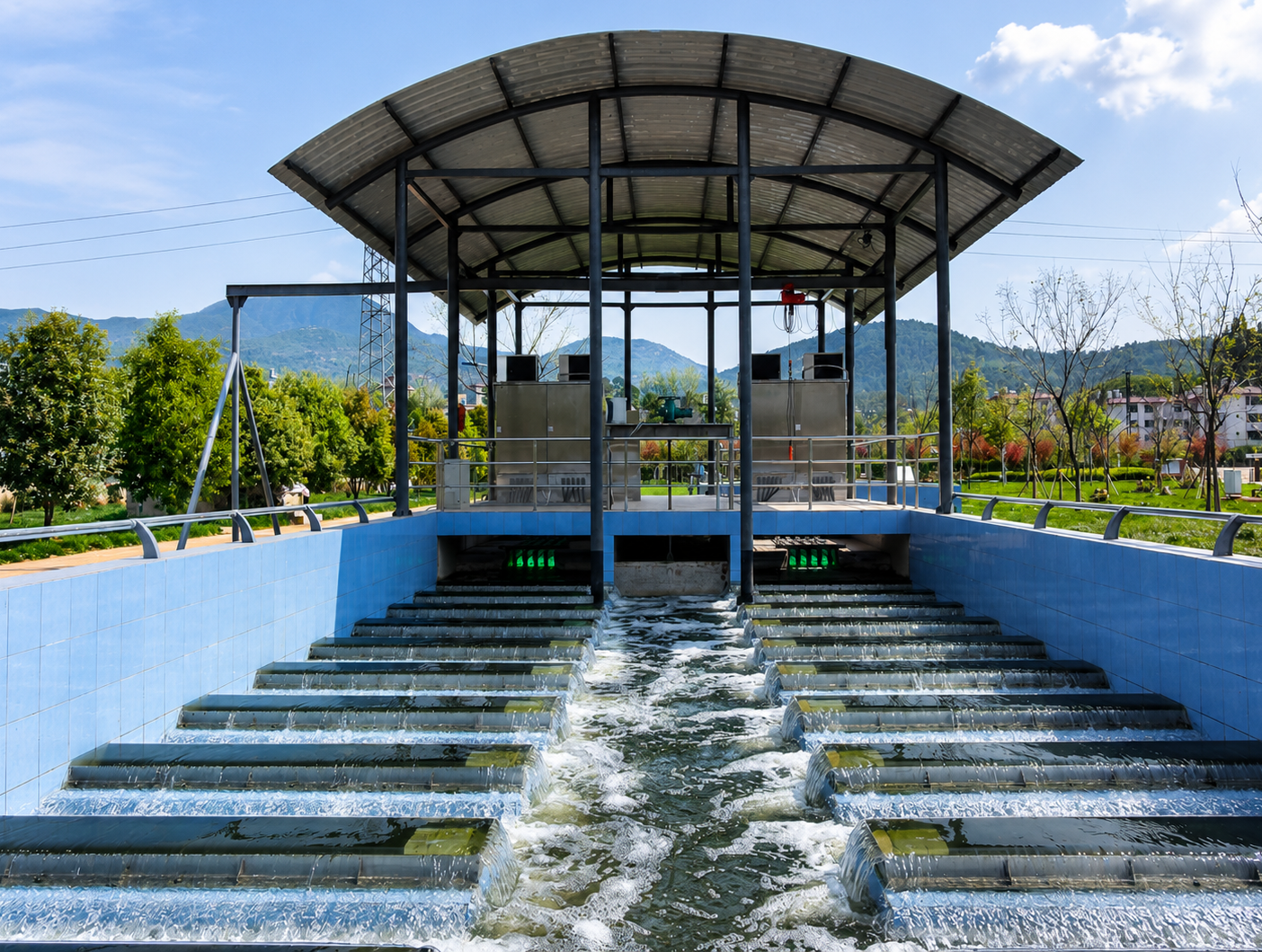
What are the advantages of UV disinfection compared with chemical disinfection?
Ultraviolet disinfection is an established alternative or complementary technology to chemical disinfection in municipal wastewater treatment, tertiary treatment and water reuse applications.
Unlike chlorination, UV disinfection inactivates microorganisms through irradiation rather than the addition of chemical disinfectants.
When correctly designed and operated, open-channel UV systems can provide effective microbial disinfection while reducing the need for chemical dosing, storage and handling.
The advantages depend on the treatment objectives, wastewater characteristics and overall plant configuration.
Reduced chemical handling and associated operational risks
Where UV replaces chlorine-based disinfection, the treatment plant may reduce or eliminate the storage, transport and dosing of chemical disinfectants associated with that treatment stage.
Potential benefits include:
Reduced handling of chlorine-based disinfectants.
Fewer chemical storage and dosing requirements.
Reduced dependence on deliveries of disinfection chemicals.
Lower exposure to risks associated with chemical handling.
Simplified operation of the disinfection stage in suitable applications.
However, some installations may still require chemical disinfection to provide a persistent residual or meet specific treatment requirements.
Effective microbial inactivation without chlorine dosing
UV-C radiation can inactivate bacteria, viruses and protozoa, including certain microorganisms that are relatively resistant to conventional chlorination.
The achievable inactivation depends on the microorganism, required reduction, delivered UV dose and water quality.
Because UV disinfection does not require chlorine addition, it avoids generating the chlorination by-products associated with that dosing process.
However, this does not mean that UV treatment is incapable of producing photochemical transformation products under all water conditions.
The complete treatment process must be evaluated according to the effluent characteristics and applicable requirements.
Automatic operation and adaptable energy consumption
Longking NLQ-H, NLQ-V and NLQ-HPV systems incorporate automatic cleaning, UV intensity monitoring and PLC-based control.
Lamp power regulation can help adapt electrical consumption to operating conditions where the installed equipment and control strategy permit it.
This provides an opportunity to optimize energy use during periods when maximum installed UV capacity is not required.
Nevertheless, UV disinfection is not inherently more energy-efficient than every chemical disinfection alternative.
A meaningful comparison must consider electricity consumption, chemical use, maintenance, treatment capacity and the required microbiological performance.
What maintenance do open-channel UV systems require?
Open-channel UV equipment is designed for automated operation, but it is not maintenance-free.
Routine maintenance and periodic inspection may include:
UV lamp condition and replacement.
Quartz sleeve cleanliness and integrity.
Automatic wiping mechanism inspection.
UV intensity sensor maintenance and calibration.
Ballasts, electrical components and control equipment.
Compressed-air supply for pneumatic cleaning systems.
Hydraulic and water-level control equipment.
Automatic quartz sleeve cleaning can reduce fouling-related maintenance requirements, but the actual cleaning effectiveness depends on the wastewater and operating conditions.
UV lamps and other components must also be managed and disposed of appropriately at the end of their service life.
Is UV disinfection a more sustainable alternative?
UV disinfection can support environmental objectives by reducing the use of chemical disinfectants and avoiding their associated storage and dosing processes.
However, the overall environmental impact depends on several factors, including:
Electricity consumption and energy source.
Chemical consumption avoided.
Lamp and component replacement.
Equipment manufacturing and material requirements.
Maintenance and waste management.
Actual operating conditions and treatment performance.
For this reason, sustainability claims should be evaluated at process or lifecycle level rather than based solely on the absence of chemical dosing.
Choosing UV disinfection for long-term operational value
The main advantage of UV disinfection is not a single characteristic, but the combination of effective microbial inactivation, automated operation and reduced reliance on chemical disinfectants where the application permits.
For wastewater treatment plants considering UV technology, the decision should evaluate disinfection performance, hydraulic compatibility, energy demand, maintenance requirements and total lifecycle cost.
Longking EnTech Europe's NLQ-H, NLQ-V and NLQ-HPV configurations provide different equipment alternatives to support this evaluation according to the requirements of each installation.
How can open-channel UV disinfection support wastewater regulations and sustainability goals?
Regulatory compliance is a key consideration when selecting ultraviolet disinfection equipment for municipal wastewater treatment, environmental discharge and water reuse applications.
Longking NLQ-H, NLQ-V and NLQ-HPV open-channel UV systems can be engineered as part of wastewater treatment processes designed to meet applicable microbiological and operational requirements.
However, regulatory compliance depends on the complete treatment installation, including influent water quality, disinfection performance, monitoring, operating conditions and any additional treatment stages required.
No UV equipment should be considered automatically compliant with a regulation solely because it uses ultraviolet disinfection technology.
EU Regulation 2020/741: agricultural water reuse requirements
Regulation (EU) 2020/741 establishes minimum requirements for the reuse of treated urban wastewater in agricultural irrigation within the European Union.
The regulation defines reclaimed water quality classes, monitoring requirements and risk management obligations according to the intended agricultural application.
UV disinfection can contribute to achieving the microbiological performance required within an appropriately designed water reclamation process.
However, the regulation addresses more than microbial inactivation. Depending on the applicable water quality class, requirements may also involve:
Microbiological water quality limits.
Suspended solids and organic matter.
Turbidity.
Routine water quality monitoring.
Validation monitoring and treatment-chain performance targets.
Water reuse risk management.
For the most demanding reclaimed water quality class, Class A, validation monitoring includes specified pathogen-indicator reduction targets for the treatment chain.
UV disinfection may contribute to these targets, but its suitability must be evaluated in combination with upstream treatment and the overall reclamation process.
EU Urban Wastewater Treatment Directive 2024/3019
The revised Urban Wastewater Treatment Directive (EU) 2024/3019 establishes an updated European framework for urban wastewater collection, treatment and environmental protection.
It addresses several areas relevant to wastewater treatment plants, including treatment performance, monitoring, energy management and the progressive introduction of quaternary treatment requirements for micropollutant removal.
Open-channel UV disinfection can form part of a wastewater treatment plant's overall treatment strategy where microbial inactivation is required.
However, conventional UV disinfection must not be confused with quaternary treatment for micropollutant removal.
Micropollutant treatment may require other technologies or specifically engineered advanced oxidation processes.
The NLQ portfolio is intended for UV disinfection; it should not be presented as a standalone solution for meeting micropollutant removal requirements.
WHO guidelines and local wastewater discharge requirements
The World Health Organization (WHO) provides guidelines for the safe use of wastewater in agriculture and aquaculture, incorporating health-based targets and risk management approaches.
These guidelines support the development and evaluation of safe wastewater reuse practices. They are not a universal product certification for UV disinfection equipment.
In addition, wastewater discharge and reuse projects may be subject to national legislation, regional regulations, environmental permits and project-specific technical specifications.
The required disinfection performance must therefore be established for each installation.
Where specific microbial reduction targets, validated UV performance or additional monitoring requirements apply, the proposed equipment and treatment process must be evaluated accordingly.
How can NLQ systems contribute to sustainable wastewater treatment?
Environmental performance is increasingly important in the design and operation of municipal wastewater treatment plants.
Longking NLQ systems can contribute to sustainability objectives through:
Microbial disinfection without the routine addition of chemical disinfectants for the UV treatment stage.
Potential reduction of chlorine storage, transport and handling where UV replaces chemical disinfection.
Automatic lamp power regulation to manage electrical consumption within the specified operating range.
Mechanical quartz sleeve cleaning to support consistent equipment operation.
Modular equipment configurations that can be evaluated for new installations and technically feasible retrofit projects.
Monitoring and automation functions that support operational supervision and maintenance.
These characteristics can provide environmental and operational advantages in suitable applications.
Nevertheless, overall sustainability depends on the complete system, including energy consumption, equipment manufacturing, component replacement, maintenance and the treatment performance achieved.
Engineering UV disinfection around project-specific requirements
The selection of NLQ-H, NLQ-V or NLQ-HPV must consider the regulatory framework alongside the technical requirements of the installation.
This includes identifying the required microbial reduction, design flow, UV transmittance, suspended solids, hydraulic constraints and applicable performance verification methodology.
Longking EnTech Europe supports the evaluation of these parameters to develop project-specific UV disinfection solutions for municipal wastewater treatment, tertiary disinfection and water reuse.
The objective is to combine effective UV disinfection, reliable operation and responsible energy management within a treatment process designed for the applicable requirements.
Find the right open-channel UV disinfection system for your project
Selecting an open-channel UV disinfection system requires more than choosing between horizontal and vertical lamps.
The right solution must combine reliable disinfection performance, suitable hydraulic integration, operational efficiency and long-term maintainability.
With three complementary configurations, Longking EnTech Europe offers engineering alternatives for different wastewater treatment requirements:
NLQ-H: Horizontal open-channel UV systems using 320 W low-pressure amalgam lamps.
NLQ-V: Vertical open-channel UV systems using 320 W low-pressure amalgam lamps.
NLQ-HPV: High-power vertical open-channel UV systems using 800 W low-pressure amalgam lamps.
Each configuration can be evaluated for municipal wastewater treatment, tertiary disinfection, water reuse and technically feasible retrofit applications.
The most appropriate system is determined by the project's disinfection requirements, wastewater quality, hydraulic conditions and lifecycle operating considerations — not simply by lamp orientation or installed power.
Longking EnTech Europe supports utilities, EPC contractors and engineering companies with UV system selection, technical sizing, hydraulic integration, automation engineering and lifecycle services.
Need help selecting between NLQ-H, NLQ-V and NLQ-HPV?
Our engineering team can evaluate your treatment requirements and identify suitable configurations for your installation.
For an initial assessment, please share:
Design flow and number of treatment channels.
UV transmittance (UVT) at 254 nm.
Total suspended solids (TSS).
Required microbiological reduction or UV disinfection performance.
Available channel dimensions and operating water levels.
Any specific project requirements or installation constraints.
Based on this information, we can assess the technical alternatives and develop a project-specific UV disinfection proposal.
Explore our open-channel UV disinfection technologies or contact Longking EnTech Europe to discuss your project.