

Cerro Dominador, Chile: 24 kg/h Containerized Ozone System for DeNOx
Plug & Play Oxygen-Fed Ozone Generation for Industrial DeNOx
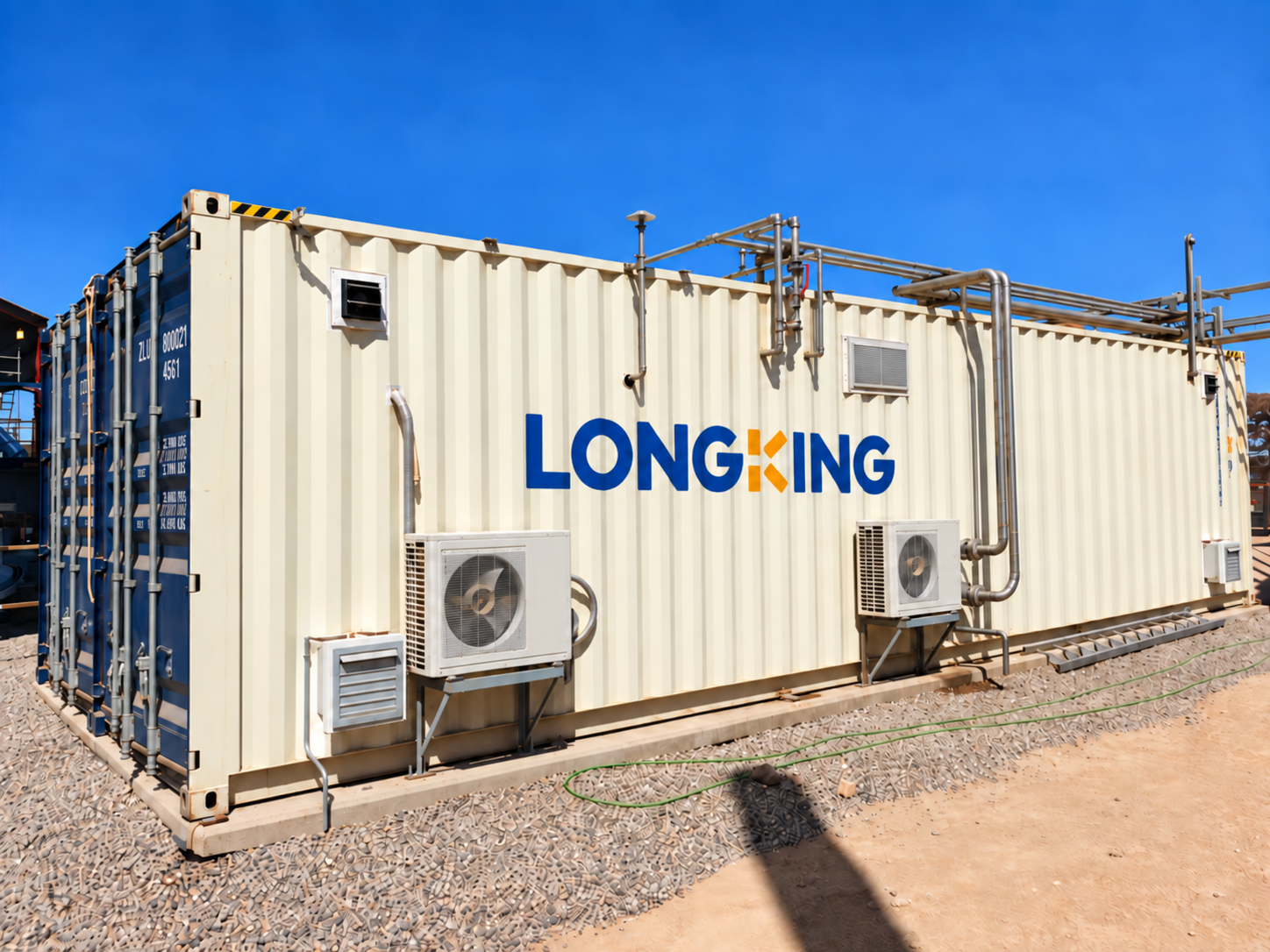
Longking supplied a 24 kg O₃/h containerized ozone generation system for the Cerro Dominador project in the Atacama Desert, Chile.
The installation is based on 2 × 12 kg O₃/h ozone generators, using oxygen as the feed gas and integrated into a complete plug & play containerized solution designed to simplify transport, installation and commissioning on site.
The ozone system is used as part of an industrial DeNOx process, where ozone acts as a powerful oxidant to convert nitrogen oxides into more oxidized forms that can be subsequently removed by the downstream treatment process.
By integrating the ozone generators and auxiliary equipment inside a dedicated container, the system provides a compact and pre-engineered package that reduces the amount of assembly and integration work required at the final installation site.
Cerro Dominador is therefore a relevant Longking reference for projects requiring containerized ozone generation, industrial emissions treatment and rapid on-site integration.
Importante: he evitado decir que “ozone removes NOx by itself”. Técnicamente, aquí debemos presentarlo como una etapa de oxidation within the DeNOx process, porque el ozono oxida NOx y la eliminación posterior depende del proceso downstream.
Project Scope & Key Data
The Cerro Dominador project combines industrial DeNOx treatment with a fully containerized ozone generation system, allowing the main ozone equipment and auxiliaries to be integrated into a pre-engineered package before delivery to site.
Key Project Data
Project: Cerro Dominador
Location: Atacama Desert, Chile
Application: Industrial flue-gas DeNOx treatment
Total installed ozone capacity: 24 kg O₃/h
Ozone generator configuration: 2 × 12 kg O₃/h
Feed gas: Oxygen
System concept: Containerized plug & play ozone package
Installation approach: Pre-integrated system designed to reduce on-site assembly and commissioning work
Containerized Ozone System Scope
The containerized concept allows the ozone generation system and its required auxiliary equipment to be integrated within a dedicated enclosure before shipment.
Depending on the final project configuration, this type of package can integrate:
Ozone generators
Feed-gas interfaces
Cooling system
Electrical distribution
Instrumentation
PLC / HMI control
Safety interlocks
Ambient ozone detection
Internal ventilation
Process connections for site integration
The exact auxiliary-equipment configuration is defined according to the project requirements and site utilities.
Why Containerization Matters
For industrial projects, containerization can significantly simplify the execution phase by reducing the amount of equipment that must be assembled and interconnected directly on site.
This approach can provide advantages in:
Factory integration
Transport and logistics
Installation time
Commissioning
Equipment protection
Site organization
Standardization of electrical and control interfaces
For remote or demanding locations such as the Atacama Desert, reducing the amount of field integration can be particularly valuable.
How Ozone Supports DeNOx Treatment
Ozone can be used as an oxidation stage within industrial DeNOx treatment systems, particularly where nitric oxide (NO) must be converted into more oxidized nitrogen species before downstream removal.
In many flue-gas streams, a significant fraction of NOx is present as NO, which is relatively difficult to remove directly through conventional wet absorption processes.
Ozone can oxidize NO into higher oxidation states that are more suitable for subsequent capture in the downstream gas-treatment process.
Ozone as an Oxidation Step
The role of the ozone system is to provide a controlled oxidation stage upstream of the final NOx-removal process.
The basic treatment logic can be represented as:
Flue gas → ozone injection → NOx oxidation → downstream absorption / scrubbing → treated gas
The final NOx removal efficiency therefore depends on the complete process, not only on the ozone generator capacity.
Ozone Dose Must Match the Flue-Gas Conditions
The required ozone production depends on the actual process conditions, including parameters such as:
Flue-gas flow
Inlet NOx concentration
NO / NO₂ distribution
Target outlet emissions
Gas temperature
Ozone injection strategy
Mixing conditions
Downstream treatment process
Required operating margin
For this reason, ozone-generator capacity should be determined from the real flue-gas composition and treatment target, rather than from gas flow alone.
Gas Mixing & Reaction Time
Once ozone is injected, effective mixing with the flue gas is essential.
Poor gas distribution can create zones with insufficient ozone exposure and reduce oxidation efficiency.
The injection system should therefore be engineered to provide appropriate:
Ozone distribution
Gas mixing
Reaction time
Injection-point location
Operating stability across the flue-gas flow range
Integration with Downstream Scrubbing
Ozone oxidation becomes particularly valuable when it is integrated with a downstream process capable of removing the oxidized nitrogen compounds.
This can include wet absorption or other gas-treatment stages designed for the specific application.
The complete DeNOx performance therefore depends on the coordinated design of: ozone production + ozone injection + gas-phase oxidation + downstream NOx removal
Why High-Capacity Ozone Generation Matters
Industrial flue-gas treatment can require substantial ozone production because the ozone demand is directly linked to the mass flow of pollutants that must be oxidized.
This makes generator reliability, oxygen supply, cooling, power consumption and control particularly important in continuous industrial applications.
At Cerro Dominador, the 24 kg O₃/h installed capacity demonstrates the use of containerized ozone generation in a real industrial DeNOx application.
Containerized Plug & Play Engineering
A containerized ozone system allows the main equipment, auxiliaries and control architecture to be assembled and integrated before delivery to site.
This reduces the amount of field work required and helps simplify installation, commissioning and coordination with the wider industrial plant.
Factory Integration Before Shipment
The container can be engineered as a self-contained ozone-generation package in which the main components are installed, interconnected and tested before dispatch.
Depending on the project configuration, this can include:
Ozone generators
Feed-gas interfaces
Cooling equipment
Electrical panels
Instrumentation
PLC / HMI controls
Internal piping
Ventilation
Ozone detection
Safety interlocks
External process connections
This allows a significant part of the integration work to be completed under controlled factory conditions.
Reduced On-Site Integration
Once delivered, the containerized system can be connected to the required site utilities and process interfaces.
This can reduce the amount of field installation associated with:
Mechanical assembly
Electrical wiring
Instrumentation
Internal piping
Control integration
Equipment protection
The exact site scope depends on the final project boundaries and civil works.
Suitable for Remote Industrial Locations
Containerized ozone systems can be especially useful for projects where the installation site is remote, difficult to access or exposed to demanding environmental conditions.
In these situations, pre-integration can help reduce dependence on extensive on-site assembly and simplify project execution.
Cerro Dominador, located in the Atacama Desert, is a clear example of an application where compact system integration and reduced field work can provide practical advantages.
Equipment Protection & Controlled Environment
The container also provides a defined enclosure for the ozone-generation equipment and associated systems.
This can support:
Environmental protection
Controlled ventilation
Equipment access
Safety zoning
Cable and piping organization
Maintenance planning
The container design itself must be adapted to the site conditions, equipment heat load, ventilation requirements and safety philosophy of the project.
Modular Project Execution
Containerization also supports a modular execution strategy.
By dividing the project into pre-engineered functional packages, interfaces between the ozone system and the wider plant can be defined more clearly before delivery.
For industrial projects, this can improve coordination between the ozone supplier, EPC contractor and final plant operator.
Automation, Safety & Environmental Conditions
Containerized ozone systems require coordinated automation and safety functions to ensure that the equipment operates within its defined limits and responds correctly to abnormal conditions.
For industrial applications such as Cerro Dominador, this is particularly important because the ozone package must integrate reliably with the wider plant while operating in a demanding site environment.
Process Monitoring & Control
The control system should continuously monitor the operating conditions of the ozone package and its main auxiliaries.
Typical monitored parameters can include:
Ozone production
Feed-gas conditions
Cooling-water status
Electrical operating parameters
Internal container conditions
Alarm status
Safety signals
External plant commands
The control philosophy should allow the ozone system to operate as part of the overall DeNOx process rather than as an isolated package.
Safety Interlocks
Ozone is a strong oxidizing gas and requires dedicated protection measures.
Depending on the final project configuration, the system can incorporate interlocks associated with:
High ambient ozone concentration
Loss of ventilation
Feed-gas failure
Cooling failure
Abnormal pressure
Electrical faults
Emergency-stop signals
External plant shutdown commands
The objective is to move the equipment to a safe operating state whenever required.
Ventilation & Ozone Detection
The container must provide appropriate ventilation for both equipment heat management and ozone safety.
Ambient ozone detection can be integrated into the safety logic so that alarms, ventilation actions or shutdown sequences are triggered when defined limits are exceeded.
The final ventilation concept depends on the equipment heat load, container layout, ambient conditions and site safety requirements.
Environmental Design
Industrial ozone containers must be engineered according to the environmental conditions of the installation site.
Relevant design factors can include:
Ambient temperature
Solar exposure
Dust
Wind
Altitude
Equipment heat rejection
Ventilation requirements
Outdoor installation conditions
For a project located in the Atacama Desert, these factors are particularly relevant to the design of the enclosure and auxiliary systems.
Integration with the Plant Control System
The ozone package can exchange operating signals, alarms and status information with the wider plant automation system.
This allows the DeNOx process to coordinate:
plant demand → ozone production → process operation → alarms and shutdown logic
The exact communication architecture and control interfaces should be defined according to the project requirements.
Why Cerro Dominador Is a Relevant Longking Reference
Cerro Dominador is a relevant Longking reference because it combines industrial flue-gas DeNOx treatment with a fully containerized 24 kg O₃/h ozone generation system in a demanding site environment.
The project demonstrates how ozone-generation technology can be integrated into a modular package designed to simplify project execution and reduce the amount of on-site installation work.
Industrial DeNOx Application
The system is used as part of an industrial emissions-treatment process in which ozone provides the oxidation stage required to convert NOx into forms that can be removed more effectively by the downstream treatment process.
This makes Cerro Dominador a useful reference for applications involving:
Flue-gas treatment
Industrial DeNOx
Ozone oxidation
Integration with downstream scrubbing
Continuous industrial operation
Containerized Ozone Engineering
The project also demonstrates the advantages of integrating the ozone system into a dedicated container.
The containerized concept allows the main equipment and auxiliaries to be assembled as a coordinated package before shipment, supporting:
Factory integration
Modular project execution
Reduced field assembly
Simplified installation
Defined utility and process interfaces
Equipment protection
Remote & Demanding Site Conditions
The location in the Atacama Desert adds an additional engineering dimension to the project.
Containerized systems for this type of environment must consider the interaction between the ozone equipment, enclosure design, cooling, ventilation and local environmental conditions.
This makes the project relevant not only as a DeNOx reference, but also as an example of ozone-system integration for remote and demanding industrial sites.
Relevant Experience for Future Projects
Cerro Dominador provides a useful reference for future projects requiring:
Containerized ozone-generation systems
Industrial DeNOx treatment
Oxygen-fed ozone generation
Remote-site deployment
Modular plug & play execution
Integration with industrial emissions-control systems
The project shows how ozone generation can be delivered as part of a complete engineered package, rather than as standalone equipment.

Need a Containerized Ozone System for an Industrial Project?
Longking EnTech Europe supports industrial projects requiring high-capacity ozone generation, containerized execution and integration with emissions-treatment processes.
Our engineering scope can include:
Ozone generation
Feed-gas integration
Cooling systems
Containerized package engineering
Electrical and control integration
Ozone safety systems
Process interfaces
Integration with downstream treatment
For DeNOx applications, the ozone system should be designed from the actual flue-gas flow, NOx concentration, oxidation target, downstream removal process and site conditions.
Contact our team with your project data and treatment requirements.